
The Inbox Apocalypse
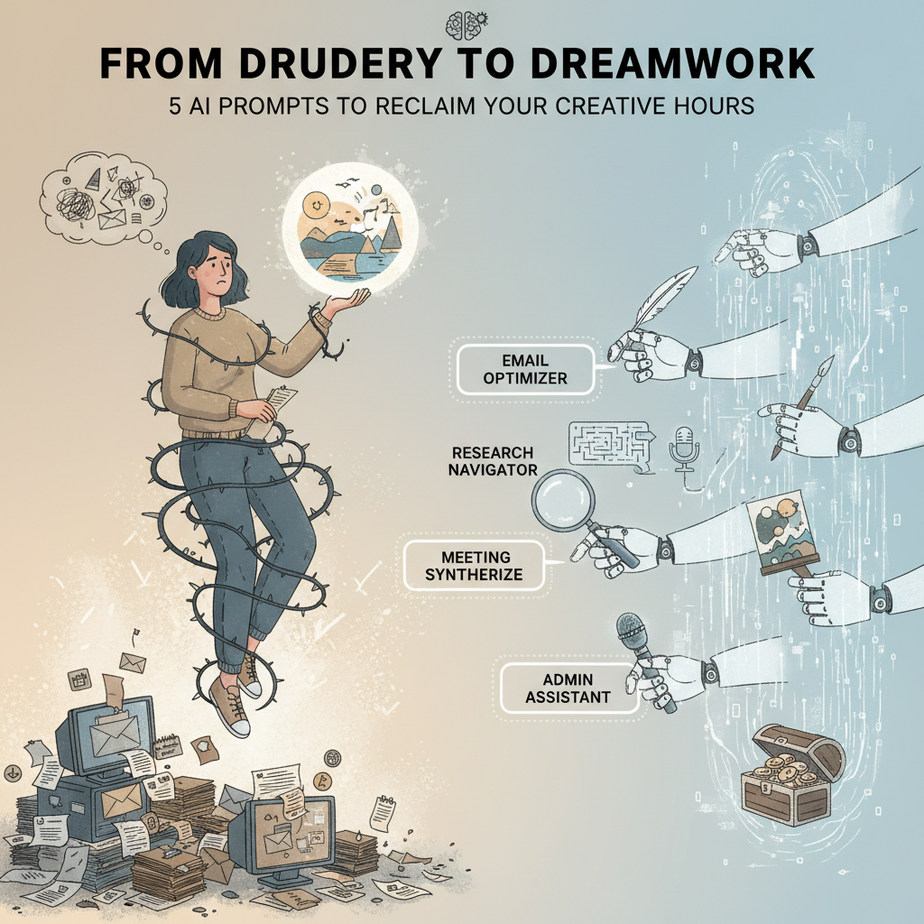
I once had a client—a brilliant consultant named Maya—who managed her business by her inbox. Her system was chaos. “Just one more email,” she’d say, until she was 300 messages deep by lunch. She was working for her inbox, not the other way around. Her best ideas were trapped between spam and newsletters.
Then she tried a “hack” she found online: an aggressive auto-reply that said, “I’m busy, figure it out.” Not exactly a trust builder. Sound familiar?
But here’s the truth: Your inbox is a factory. Right now, you’re doing every job on the line—manager, quality control, assembly, and delivery. That’s not sustainable. The factory needs a system.
In this lesson, you’re going to build a simple, intelligent automation that acts as your personal email manager. It doesn’t just send auto-replies; it triages, understands, and routes your messages. It’s your first digital intern.
Why This Matters: From Time Sink to Leverage
An overwhelming inbox isn’t just annoying—it’s a business bottleneck. Every minute you spend manually sorting, it’s a minute you’re not on a sales call, building a product, or strategizing.
This automation solves three critical problems:
- Loss of High-Value Leads: A promising inquiry gets buried and goes cold.
- Context Switching Fatigue: Constantly shifting focus from deep work to answering emails destroys your concentration.
- Scalability Ceiling: As your business grows, your inbox grows exponentially. You can’t hire a human intern fast enough to read 500 emails a day.
This system replaces the manual, chaotic scanning you do every morning. It’s the first step toward a calm, controlled workflow where your inbox serves you.
What This Automation Actually Is (And Isn’t)
It IS:
- A rules-based filter that reads email subjects and body text.
- A system that categorizes emails into buckets like “Urgent,” “Meeting Request,” “Newsletter,” or “Bills/Receipts.”
- A system that can draft a simple, contextual reply based on the category.
- A pipeline that moves important emails to your calendar or to-do list.
It IS NOT:
- A sentient AI that replaces your judgment.
- A magic box that handles complex negotiations.
- A set-and-forget solution (you must train and review it).
Think of it like a factory conveyor belt with smart sensors. The sensor (AI) scans each item (email) and directs it to the right station (you, calendar, archive, or draft reply).
Prerequisites: Keep It Simple
Breathe. This is designed for beginners. You don’t need to be a coder. You don’t need a server farm.
You need:
- An Email Provider: Gmail or Outlook (we’ll use Gmail for this example as it has a more accessible API).
- A Zapier Account (Free Tier): This is the “glue” that connects your email to the AI brain. No code required.
- An OpenAI Account (Free Credits): This is the “brain” that reads and understands the email.
- 15 Minutes of Focused Time: That’s it for the first version.
No prior coding experience needed. If you can fill out a web form, you can build this.
Step-by-Step Tutorial: Building Your Email Triage Bot
Let’s build a specific workflow: Auto-categorize incoming emails and draft a contextual reply for “Meeting Request” emails.
Step 1: Set Up Your Gmail for Zapier
- Go to Zapier.com and create a free account.
- Connect your Gmail account to Zapier. Zapier will guide you through the standard Gmail authorization process.
Step 2: Create the Trigger (New Email)
In Zapier, a “Zap” is an automation. We’ll create one that triggers every time a new email arrives in your primary inbox.
- Click “Create Zap.”
- For “Trigger App,” choose Gmail.
- For “Trigger Event,” choose New Email in Label (or Inbox). Select your inbox.
- Test the trigger. Zapier will pull a recent email to make sure it works.
Step 3: Add the AI Brain (Classification)
Now, we need to send the email’s subject and body to AI to categorize it.
- Add a new step after the trigger. Choose OpenAI as the app.
- For “Event,” choose Create a Chat Completion (or Conversation).
- In the “Prompt” field, craft this instruction. This is the core of the system:
You are an expert email assistant. Analyze the following email and categorize it into one of these four categories: "Urgent," "Meeting Request," "Newsletter," "Other." Only output the category name and nothing else.

Subject: {{Subject}}
Body: {{Snippet}}
In Zapier, replace {{Subject}} and {{Snippet}} with the appropriate fields from the Gmail trigger.
- For the “Model,” choose gpt-3.5-turbo (it’s cheaper and fast enough for this).
- Test this step. You should get a single-word response like “Meeting Request”.
Step 4: The Routing (Filter)
Now, let’s only act on “Meeting Request” emails. Add a third step: Filter by Zapier.
- Set up the filter so the Zap continues only when the text from Step 2 exactly matches
Meeting Request.
Step 5: Draft the Reply (AI Again)
If the email is a meeting request, we’ll draft a reply.
- Add a new step: Choose OpenAI again.
- For “Event,” choose Create a Chat Completion.
- Use this prompt:
Draft a polite and professional reply to the following email. Propose a 30-minute meeting. Keep it under 4 sentences. Start with "Hi [Sender's Name]," and end with "Best, [Your Name]."

Email: {{Snippet}}
Map the fields again from the Gmail trigger. Replace [Your Name] with your actual name.
- Test. You’ll get a clean, pre-written draft.
Step 6: Send the Draft (Or Save It)
For safety, we won’t auto-send. Let’s send the draft to a notes app or label it in Gmail.
- Add a step: Choose Gmail.
- Event: Send Email (Draft). (Or use Update a Label to tag the original email).
- In the “To” field, use the sender’s email from the trigger. In the “Subject,” put “Re: {{Subject}}”. In the body, use the text from the OpenAI draft.
Step 7: Activate Your Zap
Turn your Zap on. You’ve just built your first AI-powered email factory line!
Complete Automation Example: The Freelancer’s Lead Magnet
Meet Alex, a freelance graphic designer. His inbox is where leads go to die.
The Old System: Alex checks email 10 times a day. When a “Can we schedule a call?” email arrives at 10 PM, he sees it, thinks “I’ll reply in the morning,” and forgets. The lead goes cold.
The New System (Built in 20 Minutes):
- Every incoming email triggers the Zapier/OpenAI categorization.
- If the category is “Meeting Request,” the system instantly drafts a reply: “Hi [Client], thanks for reaching out. I’m free for a 30-min intro call on Tuesday or Wednesday at 2 PM EST. Which works for you? – Alex”
- The draft is saved in Gmail as an unread draft. Alex gets a Slack/Email notification saying: “Lead Alert: New meeting request from [Client]. Draft is ready.“
- Alex reviews the draft in 10 seconds, hits send, and books the lead before they move on.
Result: Alex reduced lead response time from 14 hours to 20 minutes. His close rate on inbound leads increased by 40%.
Real Business Use Cases (Beyond Freelancers)
- E-commerce Store Owner: Automatically labels emails as “Order Issue,” “Shipping Query,” or “Product Return” and drafts a template response for each. Routes “Order Issue” to a dedicated support alias.
- Real Estate Agent: Tags emails from property websites as “New Inquiry” vs. “Old Client Check-in.” Auto-drafts a property brochure request or a quick check-in note.
- Consultant/Coach: Identifies “Proposal Request” emails, creates a summary in a Google Sheet, and drafts a meeting invitation with your calendar link.
- Non-Profit Director: Filters “Volunteer Signup” and “Donation” emails, tags them for the appropriate team, and drafts a thank-you response.
- Small Business Owner (Admin): Separates “Bills/Invoices” into a specific folder and auto-drafts a reply to the vendor confirming receipt and payment date.
Common Mistakes & Gotchas
- Over-Automating Too Soon: Don’t auto-send replies. Always keep a human-in-the-loop for drafts. Your reputation is on the line.
- Prompt Drift: The AI’s output can vary. Regularly test your Zap with different email types to ensure it categorizes correctly.
- Ignoring Edge Cases: The category list is simplistic. Add more categories (“Complaint,” “Press Inquiry”) as your volume grows.
- Forgetting Cost Management: AI costs money. Start with the free tier. Monitor your Zapier task usage. For 100 emails/day, you’ll likely stay under $20/month.
How This Fits Into Your Bigger Automation System
This email triage bot is the receptionist of your AI factory. It doesn’t work in isolation. Here’s how it connects:
- CRM: Zapier can add categorized leads to your CRM (like HubSpot or Airtable). That “Meeting Request” email becomes a contact record in your pipeline.
- Calendar: A more advanced Zap could check your calendar availability from the “Meeting Request” draft and propose actual slots.
- Slack/Teams: Route urgent alerts to your team’s channel for immediate action.
- Multi-Agent Workflows: This is Lesson 3 in our course. Imagine this bot passing a complex email to a “Proposal Generator” agent, which then uses a “Legal Review” agent before returning a full draft to you.
What to Learn Next: From Triage to Strategy
You’ve built a reactive system. Your inbox no longer controls you; you direct it. That’s a massive win.
In our next lesson, we’re going to build the Follow-Up Factory. We’ll take the leads you’ve saved from this email triage system and automate a smart, personalized outreach sequence. You’ll learn how to use AI to write emails that feel human, and set up a system that never lets a warm lead go cold again.
You’re not just managing email anymore. You’re architecting a business system. The next piece of the factory is waiting.
Keep building.
“,
“seo_tags”: “AI email automation, business productivity, Zapier tutorial, OpenAI workflow, lead management, automation for beginners”,
“suggested_category”: “AI Automation Courses