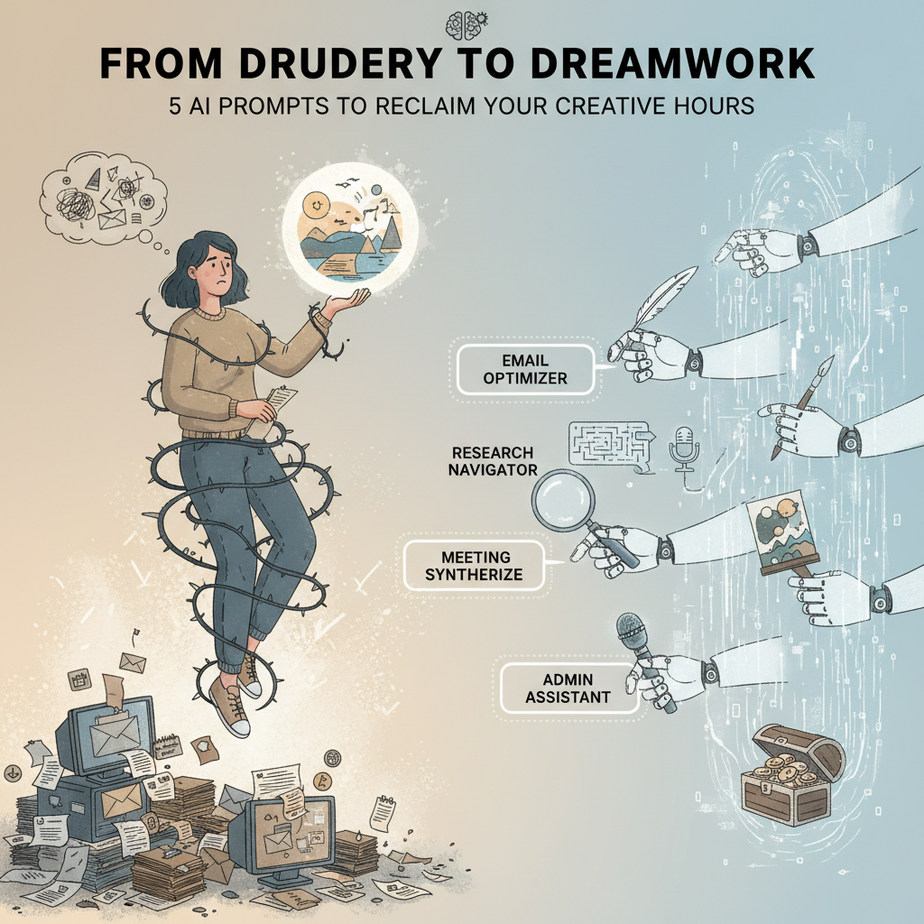

The 2:47 PM Panic
It’s 2:47 PM. You’re deep in focus work when Slack pings. Then your phone buzzes. Then another Slack. It’s a client, a lead, and a vendor, all demanding a reply. You’re a business owner, not a typing monkey. Yet, here you are, crafting the same “Thanks, we\’ll follow up” emails you\’ve written a thousand times. Your brain, the most expensive asset in your company, is being wasted on email outlines. This isn\’t a communication problem. It\’s an automation problem.
Why This Matters: Reclaiming Your Mental Bandwidth
This isn’t about sending more emails. It’s about making email disappear. We’re replacing the repetitive, low-value drafting work with an intelligent assistant. Imagine a junior intern who reads every incoming email, understands the context, knows your company’s style, and drafts a perfect first response. You just review, tweak, and send. The result: you save 1-2 hours per day, respond faster, and never send a rushed, off-tone message again. That’s the difference between a stressed operator and a strategic founder.
What This Tool Actually Is (And Isn’t)
We’re building an AI Email Drafter. It’s a lightweight script that takes an email thread or a brief, then generates a draft that’s context-aware, tonally appropriate, and ready for your review.
It IS: A drafting robot that mimics your voice for routine replies.
It IS NOT: A fully autonomous email system that sends without your input. (We are not building Skynet for your inbox. Yet.)
Prerequisites: Brutally Honest
You need:
1. A basic understanding of what an email looks like.
2. Access to an AI model with an API (like OpenAI\’s GPT-4o or a local model). You can start with a free tier.
3. A willingness to run a simple script on your computer (no server needed).
If you can use Google Docs, you can do this.
Step-by-Step Tutorial: Build Your Email Drafter
Let’s build a simple, standalone drafter. We’ll use Python and the OpenAI API for this walkthrough.
Step 1: Set Up Your Environment
Open your terminal or command prompt. Install the necessary package.
pip install openaiGet your API key from the OpenAI platform and keep it handy.
Step 2: Create the Drafter Script
Create a new file named email_drafter.py. This script will ask for the context and generate a draft.
import os
from openai import OpenAI

# Set your API key (or use environment variables for security)
client = OpenAI(api_key="YOUR_OPENAI_API_KEY")

def draft_email(user_context, tone="professional"):
    """
    Generates a draft email based on the provided context.
    """
    system_prompt = f"You are a helpful assistant drafting emails. Your tone should be {tone}. Keep the draft concise, clear, and actionable. Do not add fluff."

    user_message = f"Here is the context for the email draft: {user_context}"

    response = client.chat.completions.create(
        model="gpt-4o-mini",
        messages=[
            {"role": "system", "content": system_prompt},
            {"role": "user", "content": user_message}
        ],
        max_tokens=200
    )

    return response.choices[0].message.content

# Interactive part for testing
if __name__ == "__main__":
    print("Welcome to the AI Email Drafter.")
    print("Describe the email you need to draft (e.g., 'Respond to client Sarah about the project delay, apologetic but confident'):")
    user_input = input("> ")

    if user_input:
        print("\
Generating draft...\
")
        draft = draft_email(user_input, tone="professional")
        print("--- YOUR DRAFT ---")
        print(draft)
        print("--- END DRAFT ---")
        print("\
Copy, paste, tweak, and send!")
Step 3: Run It
Save the file and run it:
python email_drafter.pyFollow the prompt. Type your email request. Watch the AI do the work.
Complete Automation Example: The Client Follow-Up
Scenario: You need to follow up with a lead, “Acme Corp,” who downloaded your pricing guide but hasn’t responded. You want a warm, non-pushy nudge.
- Input: You run the script and type: “Follow-up email to Acme Corp. They downloaded our guide 5 days ago. Be helpful, mention the guide, and ask if they have questions. Professional tone.”
- AI Output Draft:
“Subject: Checking in on your guide download
Hi [Name],
I hope you found our pricing guide useful. I’m reaching out to see if you had any questions about what you saw or if there’s anything specific I can clarify for you. I’m here to help.
Best,
[Your Name]” - Your Action: You scan the draft, add the correct contact name and your signature, and send. Total time: 2 minutes. Instead of 15.
Real Business Use Cases
1. Real Estate Agent
Problem: Responding to dozens of listing inquiries with similar details.
Solution: Feed the property details and client question into the drafter to get a personalized, property-specific response instantly.
2. Freelance Developer
Problem: Replying to common scope questions or project updates.
Solution: Use the drafter to maintain a consistent, professional tone for all client communications, reducing context-switching.
3. E-commerce Store Owner
Problem: Replying to pre-sale questions about products.
Solution: Generate helpful, SEO-friendly responses that link to product pages, turning support into sales.
4. Consultant
Problem: Scheduling meetings and sending follow-up summaries.
Solution: Draft concise meeting recap emails or scheduling requests tailored to each client’s communication style.
5. Startup Founder
Problem: Investor updates, partnership outreach, and media queries.
Solution: Maintain a tone of authority and excitement without spending hours on each outreach email.
Common Mistakes & Gotchas
1. The “Set and Forget” Trap: Never let the AI send automatically. Always review.
2. Generic Context: Vague prompts get vague drafts. “Follow up” vs. “Follow up about the Q3 budget proposal sent on Tuesday, emphasizing the ROI section.”
3. API Costs: A single email draft costs a fraction of a cent. Still, set a budget and monitor usage.
4. Over-Automating Sensitive Emails: For delicate situations (fires, tough feedback, HR), draft by hand.
How This Fits Into a Bigger Automation System
This drafter is a single module in a larger Business Automation Engine. It connects to:
– CRM (HubSpot, Salesforce): Trigger the drafter when a lead reaches a stage. Pipe draft back to CRM.
– Email Client (Gmail/Outlook): Use a browser extension or Zapier to pre-populate drafts directly in your inbox.
– Multi-Agent Workflows: This drafter becomes the “Writing Agent” in a pipeline. An “Intake Agent” reads incoming emails, and a “Research Agent” fetches relevant data from your knowledge base (e.g., past project files) before the drafter works.
– Voice Agents: Imagine leaving a voice note for the drafter, and getting a drafted email back.
What to Learn Next
You’ve built the first line of defense for your inbox. Now, let’s scale it. In our next lesson, we’ll teach this drafter to read your past emails and perfectly mimic your style. We’ll build a Personalized Email Styler that doesn’t just draft content—it drafts in your unique voice. Think of it as cloning your writing brain. Ready to build the next layer?
“,
“seo_tags”: “AI automation, email automation, business productivity, generative AI, OpenAI API, Python automation, workflow automation, reduce email time”,
“suggested_category”: “AI Automation Courses