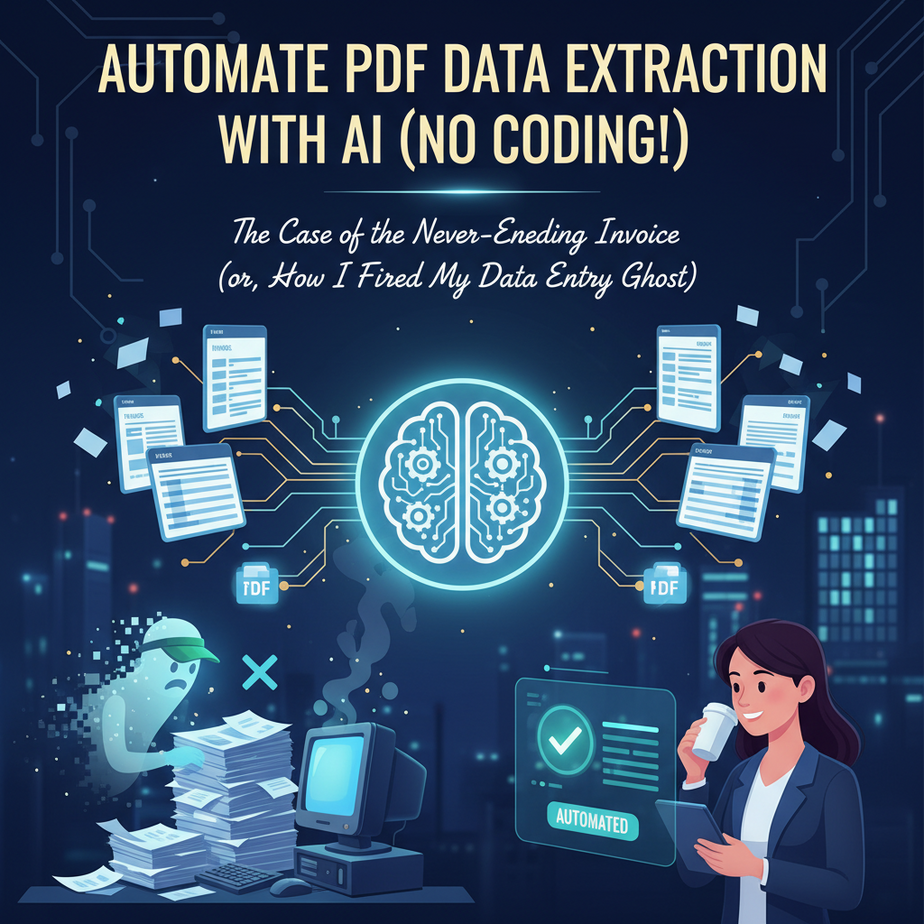
The Case of the Never-Ending Invoice (or, How I Fired My Data Entry Ghost)
Alright, class, settle in. Picture this: It’s 2 AM. The only sounds are your keyboard clacking, the hum of the fridge, and the faint, mournful cries of an invoice PDF somewhere in the digital ether. You’re hunched over, eyes glazing over, manually copying invoice numbers, dates, line items, and vendor details into a spreadsheet. Every. Single. Damn. Invoice.
It’s a scene I’ve lived, and frankly, it’s a scene I wouldn’t wish on my worst enemy’s tax accountant. It’s like being stuck in a bad ’90s office movie, except instead of a red stapler, your nemesis is a digital document that refuses to give up its secrets easily.
This soul-crushing task isn’t just about invoices. It’s contracts, applications, patient records, shipping manifests, bank statements, legal documents – anything trapped in that digital paper prison we call a PDF. It’s the kind of work that makes you wonder if you accidentally signed up for a medieval scribe apprenticeship instead of running a modern business.
Well, put down your digital quill, my friend. Today, we’re giving you a magic wand. Or rather, an AI-powered data extraction robot that will liberate you from this purgatory. Consider this your first step into a world where PDFs *beg* to give up their data.
Why This Matters: Reclaim Your Sanity (and Your Bank Account)
Let’s be brutally honest: manual data entry from PDFs is a time sinkhole, a money pit, and a sanity shredder. Here’s why you absolutely *need* to automate this:
- Time is Money (Duh): How many hours do you (or your team, or your poor intern) spend on this repetitive work? Multiply that by your hourly rate. Now imagine that time freed up for actual revenue-generating activities, strategizing, or, you know, sleeping.
- Accuracy, Not ‘Oops’: Humans make mistakes. Especially tired, bored humans. A single typo in an invoice number or a dollar amount can wreak havoc on your accounting, inventory, or customer relationships. AI? It’s remarkably accurate once trained.
- Scale, Baby, Scale: What happens when your business explodes and you suddenly have 10x the PDFs? You hire more data entry robots (humans), or you scale your existing digital robot. One is vastly cheaper and faster.
- Faster Decisions: Getting data out of documents quickly means you can analyze trends, reconcile accounts, onboard clients, or fulfill orders faster. No more waiting days for data to be processed.
This isn’t about replacing people; it’s about replacing the mind-numbing, soul-crushing tasks that make people hate their jobs. It’s about letting your team do what only humans can do: innovate, connect, and strategize. Think of it as upgrading your manual data entry intern to a super-powered data analyst who *gets* the big picture.
What This Tool / Workflow Actually Is: Your Digital Data Sniper
At its core, what we’re talking about today is Intelligent Document Processing (IDP). But let’s ditch the corporate jargon and call it what it is: an AI-powered system that can read a PDF, understand the context of the information on it, and extract specific pieces of data into a structured format (like a spreadsheet row or a database field).
What it DOES:
- Extract structured data: Think invoice numbers, dates, totals, names, addresses, product codes, line item descriptions, quantities, and prices.
- Handle variations: It can learn to pull the same data even if the layout of your PDFs changes slightly from vendor to vendor.
- Convert to usable formats: Turns messy PDFs into clean CSVs, JSON, or direct entries into other systems.
- Automate workflows: Triggers actions based on the extracted data (e.g., add to spreadsheet, send to accounting software).
What it DOES NOT do (and this is important!):
- Understand nuances of human language: It’s not a conversational AI. It won’t read between the lines of a legal contract and advise you on strategy (yet).
- Work 100% perfectly out of the box with *any* document: You usually need to "train" it by showing it examples of the documents you want to process. Think of it as teaching a very smart intern exactly where to find the "invoice number."
- Magically fix terrible scans: While good tools can handle some fuzziness, a truly unreadable scan will still be unreadable. Garbage in, garbage out, even with AI.
Think of it as training a highly specialized sniper bot. You point it at a target (e.g., "the total amount"), and it consistently hits that target, even if the target moves slightly on the page. It’s not reading the whole newspaper; it’s just finding the headlines you told it to look for.
Prerequisites: If You Can Click, You Can Conquer
Relax, breathe, have some coffee. This is not rocket science. You don’t need to be a developer, a data scientist, or even know what Python is. If you can open a web browser and click a mouse, you’re ready.
Here’s what you’ll need:
- An internet connection (obviously).
- A free account with an AI document extraction tool. (For this lesson, we’ll use a conceptual "AI Document Extractor" that mirrors capabilities of tools like Docparser, Nanonets, or Parseur, many of which offer generous free tiers for testing).
- A few sample PDFs of the type of document you want to automate (e.g., 3-5 sample invoices from different vendors). This is crucial for training.
- (Optional but recommended) A free account with an automation platform like Zapier or Make.com if you want to connect it to other apps immediately.
- A thirst for automating away tedious work!
See? No scary command lines. No cryptic code. Just simple web interfaces and a bit of pointing and clicking. You’ve got this.
Step-by-Step Tutorial: Training Your Digital Data Sniper
Let’s get your first data extractor up and running. We’ll simulate using a typical AI document extraction tool.
Step 1: Sign Up for Your AI Document Extractor
Go to your chosen tool’s website (e.g., search for "AI PDF data extraction" or "intelligent document processing free"). Sign up for a free trial or free tier. Make sure it’s a tool that allows you to define custom fields and templates. Once you’re in, you’ll typically be prompted to create a new "parser" or "template."
Step 2: Upload Your Sample PDF(s)
This is where you show the AI what kind of document it’s going to be working with. For best results, upload 2-3 examples of the *same type* of document (e.g., 3 different invoices from 3 different vendors). This helps the AI learn the commonalities and variations.
// On the tool's dashboard, look for a button like:
// "Create New Parser" or "Upload Documents"
// Select your PDF files and upload them.
Why this step: The AI needs to see real-world examples to understand the layout and where your desired data points usually live.
Step 3: Define Your Extraction Rules (Point-and-Click Training)
Now for the fun part: teaching your sniper bot where to aim. The tool will display your PDF in its interface. You’ll typically use your mouse to draw boxes or highlight the specific pieces of data you want to extract.
- Select a Field: Click or drag a box around a piece of data you want to extract. For example, highlight the "Invoice Number."
- Name the Field: The tool will ask you to name this field (e.g.,
Invoice_Number). Use clear, descriptive names. - Choose Data Type (if available): Some tools let you specify if it’s text, a number, a date, an email, etc. This helps with accuracy and formatting.
- Repeat for All Fields: Go through the entire document and highlight every piece of information you need:
Invoice_Date,Customer_Name,Total_Amount,Vendor_Address, etc. - Handle Tables (if needed): If you have line items (products, quantities, prices), most good tools have a "table extraction" feature where you can draw a box around the table and define columns. This is powerful!
Why this step: This is where you configure the AI. You’re showing it "this is what an invoice number looks like, and this is its label." The AI uses this input to build a model that can find similar data on future documents, even if they’re not identical.
Step 4: Review and Refine
After you’ve defined all your fields on one or two documents, the tool will often process the *other* sample documents you uploaded. Review the results. Did it get everything right?
- If a field is incorrect, you can often re-highlight it or adjust the extraction rule.
- If a document has a slightly different layout, you might need to "train" it on that variation too.
Why this step: Like any good intern, your AI needs feedback. This iterative process improves accuracy significantly.
Step 5: Set Up Your Output / Integrations
Once your parser is extracting data reliably, you need to decide where that data goes. Most tools offer several options:
- Download CSV/Excel: Simple, raw data in a spreadsheet.
- Webhook/API: Sends the extracted data as JSON to another application (like Zapier or Make.com). This is the key to full automation.
- Direct Integrations: Some tools have built-in connectors for Google Sheets, Salesforce, QuickBooks, etc.
For automation, we’ll focus on the webhook/API method, as it’s the most flexible.
// Look for "Integrations" or "Exports" in your tool's settings.
// Select "Webhook" or "API" as the output method.
// Copy the provided Webhook URL – you'll need this for Zapier/Make.com.
Why this step: Data isn’t useful if it’s stuck in a silo. This connects your data sniper to the rest of your digital factory.
Complete Automation Example: Invoice to Spreadsheet Magic
Let’s build a common, incredibly useful workflow: Automatically extracting data from incoming email invoices and populating a Google Sheet.
Scenario:
You receive invoices from various suppliers via email. You want to automatically extract the Invoice Number, Date, Vendor Name, and Total Amount, and add these details to a Google Sheet for reconciliation and tracking. No more manual copy-pasting!
Tools We’ll Use:
- Email Service: (e.g., Gmail, Outlook) – Where the invoices arrive.
- AI Document Extractor: (Your trained parser) – To pull data from the PDF.
- Automation Platform: (e.g., Zapier or Make.com) – To orchestrate the flow.
- Google Sheets: To store the extracted data.
The Workflow Steps:
- New Email with Attachment (Trigger): Zapier/Make.com monitors your inbox for new emails with PDF attachments (or emails sent to a specific address).
- Send PDF to AI Document Extractor (Action): The attachment from the email is sent to your trained AI Document Extractor.
- Extract Data (Action): Your AI Document Extractor parses the PDF, applies your rules, and extracts the defined fields.
- Add Row to Google Sheet (Action): The extracted data is then sent back to Zapier/Make.com, which then adds a new row to your designated Google Sheet, mapping the extracted fields to your sheet’s columns.
Let’s Build It (Conceptual Steps in Zapier/Make.com):
Part 1: Set up your AI Document Extractor (already covered above)
- Create your parser template.
- Train it with 3-5 sample invoices.
- Ensure its output is configured to send data via Webhook (copy this URL!).
Part 2: Create your Google Sheet
- Open Google Sheets and create a new blank spreadsheet.
- In the first row, add column headers that match your extracted fields:
Invoice Number,Invoice Date,Vendor Name,Total Amount.
Part 3: Build the Automation in Zapier (or Make.com)
Step 1: New Zap / Scenario (Trigger) – New Email Attachment
// In Zapier:
// Choose App & Event: Email by Zapier (or Gmail/Outlook)
// Trigger Event: New Attachment
// Set up Account: Connect your email account.
// Customize Trigger: You might specify a certain sender, subject, or even have a dedicated email address from Email by Zapier.
// Test Trigger: Send a test email with an invoice PDF to ensure it's detected.
Step 2: Send Attachment to AI Document Extractor (Action)
This is where it gets a little tricky, but it’s powerful. Most AI Extractor tools have their own Zapier integrations, OR they provide a unique email address to send documents directly. Let’s assume your AI Extractor gives you a dedicated email address (many do, like Docparser).
// If your AI Extractor has its own Zapier integration:
// Choose App & Event: Search for your AI Document Extractor (e.g., Docparser)
// Action Event: Upload Document or Parse Document
// Set up Action: Map the 'Attachment' from your email trigger to the 'Document File' field in the extractor action.

// ALTERNATIVE: If your AI Extractor provides a dedicated email to receive documents:
// Choose App & Event: Email by Zapier (or Gmail/Outlook)
// Action Event: Send Outbound Email
// Set up Action:
//   To: The dedicated email address provided by your AI Document Extractor.
//   Subject: (Optional, could be static or dynamic)
//   Body: (Optional)
//   Attachment: Map the 'Attachment' from your email trigger to this field.
Your AI Document Extractor will then receive the PDF, process it using your trained template, and (crucially) send the extracted data to the webhook URL you provided during setup.
Step 3: Catch Webhook (Trigger/Action, depending on platform)
Now, Zapier/Make.com needs to listen for the data coming *back* from your AI Document Extractor.
// In Zapier:
// Choose App & Event: Webhooks by Zapier
// Trigger Event: Catch Hook
// Set up Trigger: Zapier will give you a Webhook URL. You would have pasted this URL into your AI Document Extractor's output settings in Step 5 of the tutorial.
// Test Trigger: Go back to your AI Document Extractor, process a document, and send it to the webhook. Zapier will then catch the data.
You’ll see a payload of data pop up, containing all the fields you extracted (Invoice_Number, Vendor_Name, etc.).
Step 4: Add Row to Google Sheet (Action)
Finally, we take that beautiful, structured data and put it where it belongs.
// In Zapier:
// Choose App & Event: Google Sheets
// Action Event: Create Spreadsheet Row
// Set up Account: Connect your Google Account.
// Customize Spreadsheet Row:
//   Spreadsheet: Select the Google Sheet you created.
//   Worksheet: Select the relevant sheet (usually 'Sheet1').
//   Map Fields:
//     Invoice Number Column: Select the 'Invoice_Number' data from your Webhook step.
//     Invoice Date Column: Select the 'Invoice_Date' data from your Webhook step.
//     Vendor Name Column: Select the 'Vendor_Name' data from your Webhook step.
//     Total Amount Column: Select the 'Total_Amount' data from your Webhook step.
// Test Action: Send a test to ensure a new row appears in your Google Sheet.
And there you have it! Send a new invoice PDF to your trigger email, and watch the magic happen: the email attachment is sent to your AI extractor, data is pulled, and a new row appears in your Google Sheet, all without you lifting a finger. Your data entry ghost has officially been evicted.
Real Business Use Cases: Beyond Just Invoices
This core automation of "PDF in, structured data out" is a powerhouse across countless industries. Here are just a few examples:
-
E-commerce Store: Streamlined Supplier Onboarding
Problem: An e-commerce business receives new supplier applications via PDF forms. Each form contains company details, product categories, banking info, and contact persons. Manually entering this into their CRM and supplier database is slow and error-prone.
Solution: The AI document extractor is trained on the supplier application PDF. When a new application PDF is uploaded (or emailed), the AI extracts key fields like ‘Company Name’, ‘Contact Email’, ‘Bank Account Number’, ‘Product Categories’. This data is then automatically pushed to their CRM (e.g., HubSpot, Salesforce) and an internal supplier management system, flagging it for review by the purchasing team. Onboarding goes from days to minutes.
-
Real Estate Agency: Automated Lease Agreement Processing
Problem: A real estate agency deals with hundreds of lease agreements a month. They need to extract tenant names, move-in/move-out dates, rental amounts, and specific clauses to update their property management software and generate tenant welcome emails.
Solution: Lease agreement PDFs are fed into the AI extractor. It pulls out ‘Tenant Name’, ‘Property Address’, ‘Lease Start Date’, ‘Monthly Rent’, and ‘Security Deposit’. This data auto-populates their property management system and triggers an automated email sequence to the tenant with onboarding instructions, reducing manual follow-ups and errors.
-
Healthcare Clinic: Patient Intake Form Automation
Problem: Patients fill out paper or PDF intake forms before appointments. Clinic staff spend valuable time manually entering patient demographics, insurance details, and medical history into the Electronic Health Record (EHR) system, leading to delays and potential transcription errors.
Solution: Scanned or digital patient intake forms are sent to the AI extractor. It’s trained to pull ‘Patient Name’, ‘Date of Birth’, ‘Insurance Provider’, ‘Policy Number’, ‘Emergency Contact’, and ‘Primary Complaint’. This data then directly updates the patient’s profile in the EHR, ensuring accurate and up-to-date records before the doctor even steps into the room. Staff can focus on patient care, not data entry.
-
Financial Advisor: Client Statement Aggregation
Problem: Financial advisors receive monthly or quarterly statements from various investment firms (banks, brokerages, mutual funds) for their clients, all in different PDF formats. Aggregating client net worth and portfolio performance requires manual data entry from each statement.
Solution: The AI extractor is trained on various statement layouts. As new statements arrive, the AI extracts ‘Account Balance’, ‘Portfolio Value’, ‘Investment Gains/Losses’, and ‘Transaction Summaries’. This data is then consolidated into a master client dashboard or financial planning software, providing real-time insights for advisors and clients, and eliminating hours of tedious aggregation.
-
Logistics Company: Bill of Lading (BOL) Processing
Problem: A logistics company receives hundreds of Bill of Lading (BOL) PDFs daily, detailing shipments. They need to extract ‘Shipper’, ‘Consignee’, ‘Freight Class’, ‘Weight’, ‘Number of Pieces’, and ‘Tracking Number’ to update their dispatch system and notify customers.
Solution: BOL PDFs are automatically routed to the AI extractor. It pulls all critical shipping information. This data then populates the dispatch and tracking systems, automatically generating shipping labels, scheduling deliveries, and sending proactive tracking updates to customers, dramatically speeding up operations and reducing human error in the supply chain.
Common Mistakes & Gotchas: Don’t Trip Here!
Even with a super-smart AI, there are pitfalls beginners often tumble into. Watch out for these:
- Expecting 100% Accuracy from Day One (or Ever): AI is powerful, but it’s not magic. Especially with new document types or poor-quality scans, expect some review. The goal is *high automation*, not necessarily *perfect automation* from the start. You’ll still need a human in the loop for exceptions.
- "One Template Fits All" Thinking: If you receive invoices from 50 different vendors, chances are you’ll need to train your AI on examples from *many* of those vendors, or create multiple templates if layouts are drastically different. A generic invoice template won’t work for *every* unique layout.
- Ignoring Data Type Validation: If you’re expecting a number for "Total Amount," make sure your tool validates it as such. Otherwise, you might get "$1,234.56" as a string instead of a number, breaking calculations in your spreadsheet.
- Overlooking Security & Privacy: If you’re processing sensitive documents (medical records, financial statements), ensure your chosen AI tool is compliant with relevant regulations (GDPR, HIPAA, SOC2). Don’t just upload everything to the cheapest free tool without checking their security practices.
- Not Testing Enough Variations: Don’t just train with perfect PDFs. Test with slightly skewed, lower-resolution, or partially filled documents to see how robust your parser is. The more variations you show it, the smarter it gets.
How This Fits Into a Bigger Automation System: The Brains of Your Data Factory
Today, you’ve built a highly specialized data extraction robot. But in the grand scheme of your automation empire, this robot isn’t a lone wolf; it’s a vital cog in a much larger machine.
- CRM Integration: Extracted client data from contracts or applications can instantly update client profiles in Salesforce, HubSpot, or Zoho CRM.
- ERP/Accounting Systems: Invoice and receipt data can flow directly into QuickBooks, Xero, SAP, or custom ERPs, automating reconciliation and expense tracking.
- RAG Systems (Retrieval Augmented Generation): Imagine extracting key facts from research papers or legal documents, and then feeding that structured knowledge into a RAG system. Your AI agents could then answer complex queries based on *your specific, proprietary documents*.
- Multi-Agent Workflows: This data extractor becomes an "information gatherer" agent. It might feed its findings to a "decision-maker" agent (e.g., an AI that approves expenses based on rules), which then instructs an "action-taker" agent (e.g., an AI that initiates a payment).
- Email & Communication: Data extracted from customer feedback forms can trigger personalized email follow-ups or support tickets.
- Voice Agents: Imagine a voice agent pulling up a client’s specific contract details extracted by your system when a client calls with a query.
This isn’t just about saving time on one task. It’s about turning static documents into dynamic data streams that power intelligent, end-to-end business processes. You’re building the eyes and ears of your automated operations.
What to Learn Next: Beyond the Basics
Congratulations, you’ve just automated one of the most tedious tasks in the digital world! You’ve trained your first digital data sniper, and it’s out there, diligently extracting information.
But this is just the beginning. Our next lessons will dive deeper into:
- Advanced Table Extraction: How to handle complex tables with merged cells or dynamic rows.
- Conditional Logic: Making your automations smarter by telling them "if X is true, then do Y, otherwise do Z."
- API Integrations & Custom Code: For those who are ready to unlock even more power and flexibility by directly interacting with tools via their APIs.
- Error Handling & Monitoring: What happens when things go wrong? How to build robust systems that can fix themselves or alert you.
You now have a foundational skill in intelligent document processing. You’ve seen how to turn static information into actionable data. Keep that momentum going. The more you automate, the more time you reclaim, and the more powerful your business becomes.
Next time, we’re going to make these robots a little smarter, teaching them how to make decisions based on the data they’ve extracted. Get ready to graduate from basic data extraction to building truly intelligent workflows!
“,
“seo_tags”: “AI automation, PDF data extraction, intelligent document processing, IDP, no-code AI, business automation, workflow automation, data entry automation, machine learning, document automation”,
“suggested_category”: “AI Automation Courses