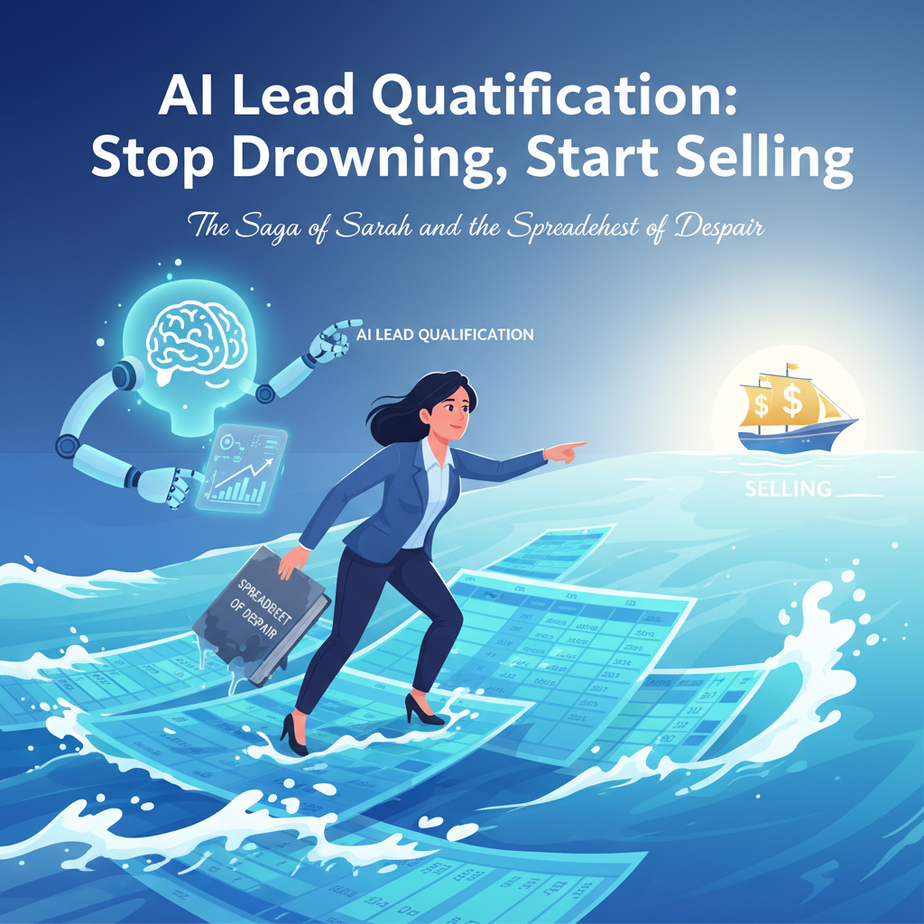
The Saga of Sarah and the Spreadsheet of Despair
Ah, the humble lead. The lifeblood of any business. And yet, for so many of you, it’s also the source of endless headaches, late nights, and the crushing realization that your ‘sales process’ is essentially a glorified game of whack-a-mole.
Meet Sarah. Sarah’s an intern. Her main job, among fetching coffees and battling the office printer, is to sort through the mountain of inbound inquiries. Demos requested, contact forms filled, newsletter sign-ups. Every single morning, she stares at a spreadsheet that mocks her very existence.
Half the entries are spam. The other half are ‘maybe’ leads, vaguely interested, or completely unqualified for what your business actually does. Sarah, bless her cotton socks, tries her best. But by 2 PM, she’s cross-eyed, powered solely by lukewarm coffee, and hot leads are chilling faster than a polar bear in a blizzard. Meanwhile, your sales team is wondering where all the ‘good’ leads are, and your competitors are probably already on a first-name basis with the ones you missed.
Sound familiar? Good. Because today, we’re ending Sarah’s suffering. And yours.
Why This Isn’t Just About Sarah’s Sanity (Though That’s Important)
This isn’t just a feel-good story about saving an intern from spreadsheet-induced madness. This is about cold, hard business outcomes. When you automate lead qualification and follow-up with AI, you are:
- Increasing Sales Efficiency: Your sales team stops chasing ghosts. They only talk to leads who actually fit your ideal customer profile. Imagine the time saved. Imagine the frustration avoided.
- Achieving Faster Lead Response Times: Hot leads wait for no one. Every minute a qualified lead sits in an inbox, they’re looking at your competitors. AI responds instantly, day or night.
- Improving Lead Quality for Sales Teams: Your sales reps get pre-vetted, pre-categorized leads. They know exactly who they’re talking to and what their potential needs are, empowering them to close deals faster.
- Reducing Manual Data Entry & Errors: No more copy-pasting from forms to CRMs. No more mistyped emails. The robots handle the boring, repetitive stuff with ruthless accuracy.
- Enabling Personalized Customer Journeys at Scale: The AI doesn’t just categorize; it helps you trigger *specific* follow-ups. A ‘hot’ lead gets a different email sequence than a ‘warm’ lead. This isn’t just automation; it’s personalized automation.
In short, you’re not just replacing an intern; you’re upgrading your entire sales and marketing funnel from a leaky bucket to a precision-guided missile system. More revenue, less headache. That’s the Professor Ajay guarantee.
What This Tool / Workflow Actually Is
Think of this system as your business’s ultimate digital bouncer and concierge. When a new inquiry comes knocking, our AI bouncer will immediately check its ID, assess its vibe, and decide if it’s a VIP, a casual browser, or just someone trying to sneak in without a ticket.
Here’s how it works:
You’ll connect your lead sources (website forms, incoming emails, even social media DMs) to an automation platform like Zapier or Make.com. When a new lead arrives, this platform will scoop up all the relevant information and send it to an LLM (Large Language Model) like OpenAI’s GPT-4o or Anthropic’s Claude 3.5 Sonnet.
The LLM, armed with your specific qualification criteria, will then analyze the lead. It will tell us if it’s a ‘Hot,’ ‘Warm,’ or ‘Cold’ lead, extract key details, and often even suggest the next best action. Once the LLM makes its judgment, the automation platform takes over again, routing the lead to the correct destination: your CRM, a specific email sequence, a Slack notification for your sales team, or even just a ‘thank you for your interest’ email for those who aren’t quite a fit yet.
What it DOES:
- Automatically score and categorize leads based on rules you define.
- Extract key data points from unstructured text (e.g., a message in a contact form).
- Trigger personalized follow-up actions instantly.
- Save countless hours of manual review.
What it DOES NOT do:
- Magically close sales for you (you still need humans for that… for now).
- Understand subtle human emotions or build complex rapport beyond initial contact.
- Replace the need for a well-defined sales strategy. It just executes it better.
Consider it your 24/7, highly intelligent lead processing factory. No coffee breaks, no complaining, just pure, unadulterated efficiency.
Prerequisites (Don’t Worry, No Rocket Science Here)
Alright, before we dive in and get our hands dirty (metaphorically speaking, of course), let’s make sure you have your toolkit ready. Think of these as the ingredients for your automation recipe. You don’t need to be a Michelin-star chef, just someone who can follow instructions.
- An Automation Platform Account: You’ll need either Zapier or Make.com. Both offer generous free tiers to get started, so no excuses about budget. If you’ve never used them, don’t sweat it. We’ll walk through it.
- An LLM API Key: We’ll primarily use OpenAI for this, so you’ll need an OpenAI API key. You’ll need to set up billing, but usage is pay-as-you-go and incredibly cheap for these kinds of tasks (we’re talking pennies, not dollars, per month for most small businesses). Other LLMs like Anthropic’s Claude also work great.
- A CRM (Customer Relationship Management) System: This is where your leads live. HubSpot, Pipedrive, Salesforce, Zoho CRM, even a simple Google Sheet can work as a starting point.
- An Email Marketing Platform: To send those personalized follow-up emails. Think Mailchimp, ActiveCampaign, ConvertKit, etc.
- A Lead Capture Source: A website form (Typeform, Google Forms, your native website forms), an email inbox you monitor, or even a webhook from a social media tool.
- A Brain & A Bit of Patience: You bring the curiosity, I’ll bring the expertise. You absolutely do NOT need to be a coder. Just a curious automator.
Got all that? Excellent. Let’s make some magic happen.
Step-by-Step Tutorial: Building Your AI Lead Qualification Engine
We’re going to build the core logic for qualifying a lead using an LLM and then setting up the automation. For this tutorial, we’ll use Zapier as our automation platform and OpenAI for the LLM. Make.com users will find the concepts very similar, just different UI elements.
1. Define Your Lead Qualification Criteria
Before any AI can help, *you* need to tell it what a ‘good’ lead looks like. This is crucial. Grab a piece of paper (or open a doc) and clearly list:
- Qualification Levels: What are your categories? (e.g., Hot, Warm, Cold, Spam, Nurture).
- Criteria for Each Level: What specific data points make a lead ‘Hot’? (e.g., ‘Budget > $10,000’, ‘Job Title includes CEO/Founder’, ‘Mentions specific service X’, ‘Company size > 50 employees’). Be as explicit as possible.
- Desired Extracted Data: What information do you always want to pull out of the lead’s message? (e.g., Company Name, Contact Email, Primary Interest, Budget Range, Urgency).
Example Hot Lead Criteria: Project budget over $10k, needs Cloud Migration, company size > 50 employees, contact role is decision-maker.
2. Craft Your LLM Prompt for Classification
This is where the AI gets its marching orders. A good prompt tells the LLM exactly what its job is, what rules to follow, and how to deliver the output. We want structured output, so we’ll ask for JSON.
Go to the OpenAI Playground (or directly use the API). Choose a model like ‘gpt-4o’.
You are an expert lead qualification specialist for a tech consulting firm. Your task is to analyze incoming lead inquiries and classify them into one of three categories: 'Hot', 'Warm', or 'Cold'. You must also extract key information.

Here are the classification rules:
-   **Hot Lead:** Budget specified is $10,000 or more AND the primary interest is 'Cloud Migration' or 'AI Implementation' AND the company size mentioned is '50+' employees.
-   **Warm Lead:** Budget is not specified or is under $10,000, BUT the primary interest is clearly related to IT services, and the company size is '10-49' employees.
-   **Cold Lead:** Budget is very low or irrelevant, interest is vague or outside of core IT services, or company size is less than 10. Also, classify as Cold if it appears to be spam or completely unqualified.

Extract the following information:
-   `classification`: (Hot, Warm, Cold)
-   `company_name`: (Extract company name if available)
-   `contact_email`: (Extract email address if available)
-   `primary_interest`: (Briefly summarize their main service interest)
-   `budget_range`: (Extract any mentioned budget, e.g., '$5k', '$10k+', 'not specified')
-   `sales_notes`: (A brief, compelling note for the sales team, maximum 2 sentences)

Always output your response in JSON format. Do not include any other text or explanation.

Here is the lead inquiry:

{LEAD_INQUIRY_TEXT}
Replace {LEAD_INQUIRY_TEXT} with a sample lead (e.g., ‘Hi, I’m John from Acme Corp. We need help with moving our servers to the cloud, aiming for a $15,000 budget. We have about 75 employees. My email is john@acmecorp.com.’). Test this prompt until you consistently get the desired JSON output.
3. Set Up Your Zapier Workflow (The Automation Backbone)
Now, let’s connect everything. Go to Zapier and click ‘Create Zap’.
Step 3a: Trigger – New Lead Submission
- Choose Trigger: Select your lead source. For a website form, you might choose ‘Typeform’ -> ‘New Entry’, or ‘Webhooks by Zapier’ -> ‘Catch Hook’ if your form sends data directly. If it’s a new email, choose ‘Gmail’ -> ‘New Email’.
- Connect Account & Test Trigger: Follow Zapier’s prompts to connect your account and test the trigger. Submit a sample lead through your form to get real data.
Step 3b: Action – Send Lead Data to LLM (OpenAI)
- Choose Action: Search for ‘Webhooks by Zapier’ (this is the most flexible way to call any API, including OpenAI). Select ‘POST’.
- Customize Request:
- URL:
https://api.openai.com/v1/chat/completions - Payload Type:
Json - Data: This is the body of your request. It’s essentially the prompt we just created.
{ "model": "gpt-4o", "messages": [ { "role": "system", "content": "You are an expert lead qualification specialist... [PASTE THE FULL PROMPT FROM STEP 2 HERE, including the rules and desired output format]" }, { "role": "user", "content": "Hi, I’m {{1.Your Form Field with Lead Message}}. My email is {{1.Your Form Field with Lead Email}}... [MAP ALL RELEVANT FORM FIELDS HERE]" } ], "response_format": {"type": "json_object"}, "temperature": 0.7 } - URL:
- Headers:
Content-Type: application/jsonAuthorization: Bearer YOUR_OPENAI_API_KEY(Replace `YOUR_OPENAI_API_KEY` with your actual key from OpenAI. Keep this secret!)
- Test Action: Run a test. You should see a JSON response from OpenAI with your classification!
Step 3c: Action – Parse LLM Response
The LLM’s response will be nestled inside a few layers of JSON. We need to extract just our classification and data.
- Choose Action: Search for ‘Formatter by Zapier’. Select ‘Utilities’ -> ‘Convert to JSON’.
- Transform: Map the ‘choices__0__message__content’ field from your Webhooks step. This is where the LLM’s JSON output lives.
- Test Action: This will make the LLM’s JSON output directly usable in subsequent steps.
Step 3d: Action – Router (Conditional Logic)
This is where we direct traffic based on the AI’s classification. In Zapier, this is called ‘Paths’.
- Choose Action: Search for ‘Paths by Zapier’. Add 3 paths: ‘Hot Lead’, ‘Warm Lead’, ‘Cold Lead’.
- Set Up Path A (Hot Lead):
- Filter: Set a filter where ‘Classification’ (from your Formatter step) ‘Exactly matches’ ‘Hot’.
- Continue building this path…
- Set Up Path B (Warm Lead):
- Filter: Set a filter where ‘Classification’ ‘Exactly matches’ ‘Warm’.
- Continue building this path…
- Set Up Path C (Cold Lead):
- Filter: Set a filter where ‘Classification’ ‘Exactly matches’ ‘Cold’.
- Continue building this path…
Now, let’s flesh out each path.
Complete Automation Example: The Tech Consulting Firm’s Dream
Let’s put it all together. Imagine you run ‘Apex Innovations,’ a tech consulting firm specializing in cloud migration and AI solutions. You get inquiries through your website’s Typeform.
Goal:
Automatically qualify leads: ‘Hot’ leads (high budget, specific service, large company) get immediate sales attention and a personalized outreach. ‘Warm’ leads get a nurture email sequence. ‘Cold’ leads get a polite decline or general info.
The Workflow in Zapier:
- Trigger: Typeform – New Entry
- Setup: Connect your Typeform account, select your ‘Contact Us’ form. Test to pull in a sample entry.
- Example Data:
- Name: John Doe
- Email: john.doe@acmecorp.com
- Company Size: 75 employees
- Project Description: “We need to move all our legacy systems to AWS and potentially explore AI solutions. Our budget is around $20,000 for this first phase.”
- Action: Webhooks by Zapier – POST (Call OpenAI GPT-4o)
- Configuration: Use the prompt from Step 2, mapping the Typeform fields to the
{LEAD_INQUIRY_TEXT}placeholder. - Output (after parsing with Formatter):
{
  "classification": "Hot",
  "company_name": "Acme Corp",
  "contact_email": "john.doe@acmecorp.com",
  "primary_interest": "Cloud Migration & AI Solutions",
  "budget_range": "$20,000",
  "sales_notes": "Decision-maker, high budget, clear need for core services. Follow up ASAP."
}
- Configuration: Use the prompt from Step 2, mapping the Typeform fields to the
- Action: Paths by Zapier – Choose Path Based on Classification
- Path A: Hot Lead (if Classification is “Hot”)
- Action 1: HubSpot – Create Contact / Update Contact
- Map `contact_email` to Email, `company_name` to Company.
- Set ‘Lifecycle Stage’ to ‘Lead’, ‘Lead Status’ to ‘AI Qualified – Hot’.
- Add `sales_notes` to a custom field for sales.
- Action 2: Slack – Send Channel Message
- Channel: #sales-team-alerts
- Message:
🚨 NEW HOT LEAD: {{company_name}} ({{contact_email}}) - Interest: {{primary_interest}}. Budget: {{budget_range}}. Sales Notes: {{sales_notes}}
- Action 3: ActiveCampaign – Create/Update Contact & Add to Automation
- Add contact to a list.
- Start automation: ‘Hot Lead Nurture Sequence – Sales Outreach’. (This sequence sends a personalized email from the sales rep, then schedules a task for them to call).
- Action 1: HubSpot – Create Contact / Update Contact
- Path B: Warm Lead (if Classification is “Warm”)
- Action 1: HubSpot – Create Contact / Update Contact
- Set ‘Lead Status’ to ‘AI Qualified – Warm’, ‘Lifecycle Stage’ to ‘Marketing Qualified Lead’.
- Action 2: ActiveCampaign – Create/Update Contact & Add to Automation
- Start automation: ‘Warm Lead Nurture Sequence – Educational Content’. (This sequence sends a series of case studies, whitepapers, and general industry insights over a few weeks).
- Action 1: HubSpot – Create Contact / Update Contact
- Path C: Cold Lead (if Classification is “Cold”)
- Action 1: HubSpot – Create Contact / Update Contact
- Set ‘Lead Status’ to ‘AI Qualified – Cold’, ‘Lifecycle Stage’ to ‘Subscriber’.
- Add a tag ‘Not-a-Fit’.
- Action 2: ActiveCampaign – Create/Update Contact & Add to Automation
- Start automation: ‘Cold Lead – General Newsletter’. (Adds them to your general email list for future potential engagement, but no immediate sales outreach).
- Action 1: HubSpot – Create Contact / Update Contact
- Path A: Hot Lead (if Classification is “Hot”)
And just like that, John Doe’s inquiry is immediately classified as ‘Hot’, a sales alert goes out, his contact is updated in the CRM, and a personalized email is on its way, all without Sarah lifting a finger. She can now focus on… well, probably still making coffee, but at least the important stuff is handled.
Real Business Use Cases (Beyond Tech Consulting)
This automation isn’t just for tech companies. Every business with inbound inquiries can benefit. Here are a few examples:
-
E-commerce (High-Ticket Items – e.g., Custom Furniture Maker)
- Problem: Many inquiries about custom designs, but only a few are serious buyers with the budget for bespoke pieces. Manual sifting is time-consuming.
- Solution: AI analyzes the inquiry (mentions of specific materials, size, urgency, budget range from a ‘request a quote’ form). It classifies leads as ‘Ready to Buy’ (high budget, detailed specs), ‘Exploring Options’ (vague, asking for general pricing), or ‘Window Shopper’. ‘Ready to Buy’ leads get routed directly to a design consultant, ‘Exploring Options’ get a gallery of past work and material samples, ‘Window Shoppers’ receive a general newsletter.
-
SaaS Startup (Demo Requests)
- Problem: Getting hundreds of demo requests, but many are students, competitors, or small businesses not fitting the ideal enterprise customer profile. Sales team wastes time on unqualified demos.
- Solution: AI processes the demo request form (company size, industry, job title, specific pain points mentioned). It classifies as ‘Enterprise Fit’ (high priority for a sales demo), ‘SMB Fit’ (routed to a self-serve demo or lower-tier sales rep), or ‘Not a Fit’ (student/competitor, sent to a knowledge base).
-
Real Estate Agency (Property Inquiries)
- Problem: Flood of inquiries for properties, but clients often don’t meet budget requirements or have specific location needs that agents have to manually filter.
- Solution: AI analyzes inquiries from property listing sites (budget range, number of bedrooms, desired location, urgency). It qualifies leads as ‘Serious Buyer’ (meets criteria, high urgency), ‘Browsing’ (vague, low urgency), or ‘Unqualified’. ‘Serious Buyers’ get an immediate call from an agent, ‘Browsing’ leads receive curated listings, ‘Unqualified’ leads get general market info.
-
Coaching/Consulting (Application Forms)
- Problem: High-end coaches receive many applications for their programs, but need to ensure applicants are committed and financially capable. Screening takes hours.
- Solution: AI processes application forms (current income, specific goals, commitment level, stated challenges). It classifies applicants as ‘High Potential’ (fits ideal client profile, ready for discovery call), ‘Good Fit – Nurture’ (potential, but needs more info/education), or ‘Not a Fit’. High potential applicants are booked for a call; others get targeted content or polite rejections.
-
Recruiting Agency (Candidate Applications)
- Problem: Overwhelmed by resumes and cover letters for multiple roles. Manually checking each for core requirements (experience, skills, qualifications) is inefficient.
- Solution: AI ingests resume text and cover letter content. Using criteria for specific job openings, it classifies candidates as ‘Strong Match’, ‘Potential Match’, or ‘Not a Match’. ‘Strong Matches’ are immediately added to a shortlist and an interview request is sent; ‘Potential Matches’ are added to a talent pool for future roles; ‘Not a Match’ receive an automated ‘thank you, but no’ email.
Common Mistakes & Gotchas (Learn from My Scars)
As your wise old Professor, I’ve seen enough automation mishaps to fill a small library. Here are the common traps you’ll want to avoid:
-
Vague LLM Prompts: Garbage In, Garbage Out
Your AI is only as good as your instructions. If your qualification criteria in the prompt are vague (‘Find good leads’), the AI will give you vague results. Be excruciatingly specific. Define ‘good,’ define ‘hot,’ define ‘budget.’ Use examples in your prompt if necessary.
-
Over-Reliance & Not Testing Thoroughly
Don’t just set it and forget it! Test every single path, every classification, every integration. Send dozens of dummy leads through your system. What happens if the lead leaves a field blank? What if they swear profusely? The AI isn’t infallible, and Zapier/Make connections can break. Monitor your zaps/scenarios.
-
Ignoring Edge Cases & Incomplete Data
What if the lead provides *no* budget? Or *no* company size? Your prompt needs to account for this. Build in ‘default’ classifications or specific instructions for missing data (e.g., ‘If budget is not specified, classify as Warm’). Otherwise, your automation might just throw an error or misclassify.
-
Forgetting Data Privacy and Security
You’re sending sensitive lead data to third-party AI models. Ensure you understand the data policies of your LLM provider (e.g., OpenAI’s API data usage policy). For very sensitive data, consider self-hosting or highly regulated LLMs, or redacting information before sending it. Always be compliant with GDPR, CCPA, etc.
-
Trying to Automate the Entire Sales Conversation (Too Soon)
This automation qualifies and initiates. It’s not designed to handle complex objections or close deals. Push too much onto the AI too early, and you’ll frustrate leads and damage your brand. Use it for the initial heavy lifting, then pass to a human or a more specialized follow-up agent.
How This Fits Into a Bigger Automation System
What we’ve built today is a powerful standalone automation, but it’s also a foundational block in a much larger AI-powered business ecosystem. Think of it like building the specialized filtering system for your automated factory. Here’s how it connects:
- CRM (Customer Relationship Management): Our current system already integrates. But this is just the start. The AI’s classification and notes can enrich CRM profiles, triggering specific sales sequences or tasks *within* the CRM, like ‘Call in 5 minutes’ or ‘Assign to Senior Sales Rep’.
- Email Marketing & SMS: Beyond basic follow-ups, the AI could dynamically generate *hyper-personalized* email content based on the lead’s extracted interests, even suggesting specific product recommendations or relevant case studies before a human ever gets involved.
- Voice Agents / Chatbots: Imagine an initial chatbot interaction on your website that collects lead data. This data is then immediately fed into *our* qualification system, allowing the chatbot to dynamically shift its conversation to match the lead’s hotness level, or even transfer ‘Hot’ leads directly to a human agent.
- Multi-Agent Workflows: This qualification step can be the very first agent in a chain. Agent 1 (our qualification AI) identifies a ‘Hot’ lead. Agent 2 (a specialized ‘Proposal Drafting AI’) then takes the extracted interests and budget, searches your product database, and drafts a preliminary proposal. Agent 3 (a ‘Scheduling AI’) then suggests meeting times.
- RAG (Retrieval Augmented Generation) Systems: To make the LLM even smarter, you could implement RAG. Before the LLM classifies, it could query your company’s internal knowledge base (product docs, FAQs, past proposals) to better understand niche requests from leads. This allows for incredibly accurate classification and richer ‘sales notes’ based on your proprietary information.
This isn’t just about qualifying leads; it’s about building intelligent pipelines that continuously feed your business with exactly what it needs, when it needs it.
What to Learn Next: Unleashing Autonomous AI Follow-Up
Congratulations, you’ve just graduated from the ‘Drowning in Leads’ club! You’ve built a robust system that ensures no hot lead ever goes cold again, and your sales team can finally focus on what they do best: selling.
But what if we could take this a step further? What if, instead of just sending a pre-written email, your AI could actually *engage* with that ‘Warm’ lead? What if it could answer their initial questions, provide relevant resources, and even nudge them towards booking a demo, all autonomously?
That’s exactly what we’ll tackle in our next lesson: **Building AI Agents for Autonomous Lead Nurturing.** We’ll dive into how to create AI agents that can handle multi-turn conversations, dynamically fetch information, and proactively move leads further down your funnel, freeing up even more of your valuable time.
Get ready to unleash the true power of AI for your business. Class dismissed… for now. But don’t stray too far – the robots are just getting started.