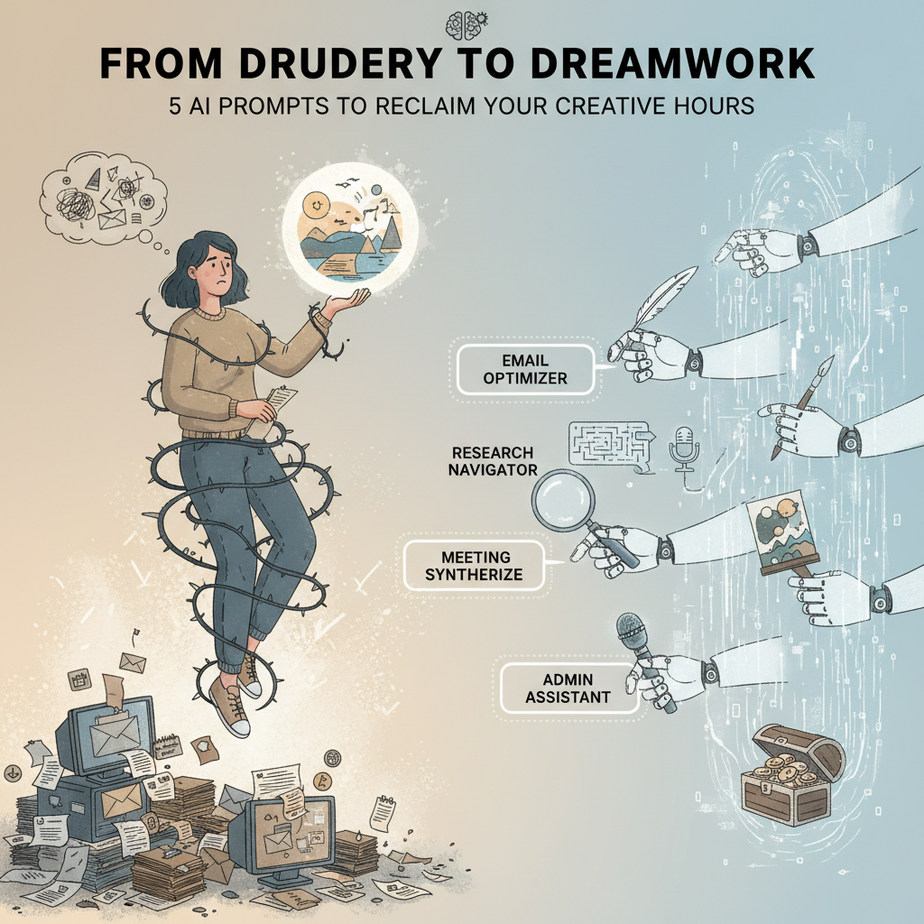

The Case of the Overwhelmed Sales Team (and the Exploding Inbox)
Picture this: Sarah, a new sales rep, starts her day with a fresh cup of coffee and an inbox that looks like it’s been mugged by a thousand spam bots. Mixed in with genuine inquiries are support requests, vague ‘tell me more’ emails, discount hunters, and, of course, the ever-present ‘Nigerian Prince’ offering a deal too good to be true. Sarah spends the first two hours of her day doing one thing:
Triaging.
Reading, skimming, forwarding, deleting, trying to figure out if ‘john.doe@randomcompany.com’ actually has a budget or if they just want a freebie. She’s basically an overqualified, underpaid digital mail sorter. By the time she gets to a truly promising lead, it’s often hours later, and that lead has probably moved on to a competitor who actually responded.
Sound familiar? That’s the sound of money walking out the door, folks. And it’s precisely why we’re teaching this lesson today.
Why This Matters: Stop Paying Humans to Be Robots (and Start Closing Deals)
Manual lead qualification isn’t just boring; it’s a revenue killer. Every minute your sales team spends sifting through junk is a minute they’re NOT selling. It leads to:
- Slow Response Times: High-value leads don’t wait.
- Burnout: Your top performers get tired of the grunt work.
- Missed Opportunities: Good leads get lost in the noise.
- Inefficient Resource Allocation: Junior reps chasing ghosts, senior reps doing admin.
What if you had a tireless, always-on ‘digital intern’ – let’s call him your AI Sales Bouncer – who could read every incoming email, instantly understand the intent, pull out key details, qualify it against your criteria, and then immediately push it to the right person or system? No breaks, no coffee, no complaints. Just pure, unadulterated efficiency.
That’s what we’re building today. A system that takes your sales inbox from a chaotic warzone to a streamlined, revenue-generating machine. You’ll reduce manual triage by 80% or more, allowing your human sales team to do what they do best: build relationships and close deals.
What This Tool / Workflow Actually Is: Your Smart Email Pipeline
This isn’t some fancy, theoretical AI concept. This is a practical, implementable workflow that connects your email inbox to a smart AI, then routes the results based on rules you define. Think of it as an automated pipeline:
- Inquiry Ingestion: Your email comes in.
- AI Analysis (The Brains): Our AI Sales Bouncer reads the email, extracts critical information (company, contact, needs, budget), and assesses its quality.
- Qualification Decision: Based on your rules, the AI determines if it’s a ‘High’, ‘Medium’, ‘Low’ priority, or just plain spam.
- Automated Action (The Hands): The lead is then instantly routed: maybe to a senior sales rep’s CRM, a junior rep’s queue, an automated nurture sequence, or simply archived.
What it does NOT do: This AI will NOT replace your sales team. It’s not closing deals, building rapport, or negotiating. It’s the ultimate prep cook, making sure your chefs (your sales team) only get the finest, prepped ingredients, ready for cooking.
Prerequisites: Let’s Get Our Tools Ready
Don’t worry, this isn’t rocket science, and you don’t need to be a coding wizard. If you can click buttons and copy-paste, you’re good. Here’s what you need:
- An Email Account: Gmail or Outlook. (This is where your leads land).
- An Automation Platform Account: Make.com or Zapier. Both offer free tiers to get started. I’ll mostly use Make.com visuals, but the principles are identical for Zapier.
- An OpenAI Account with API Access: This is where our AI brain lives. You’ll need to add a payment method for API usage, but initial costs are usually negligible for testing. Think a few cents per lead.
- A Target System: Somewhere to send your qualified leads. This could be a Google Sheet, a CRM (like HubSpot or Salesforce), a Slack channel, or another email address. For this tutorial, we’ll use a simple Google Sheet and a Slack notification.
- A Brain and a Coffee: Essential for learning.
That’s it. No custom servers, no complex infrastructure. Just a few online accounts and your trusty web browser.
Step-by-Step Tutorial: Building Your AI Sales Bouncer
We’re going to build this using Make.com (formerly Integromat), but the logic applies directly to Zapier, Pipedream, or any other automation platform. Think of these platforms as digital Lego sets.
Step 1: Set Up Your Email Trigger
First, we need to tell our automation when a new email comes in.
- Create a New Scenario in Make.com: Click ‘Create a new scenario’.
- Add Your Email Module: Search for ‘Email’ or ‘Gmail’ / ‘Outlook’. Select ‘Watch emails’.
- Connect Your Account: Authenticate your Gmail/Outlook account.
- Configure the Email Search:
- Folder: Select ‘Inbox’.
- Criteria: This is important. You don’t want *every* email. You might filter by emails to a specific sales address (e.g., ‘sales@yourcompany.com’) or emails containing keywords like ‘inquiry’, ‘quote’, ‘demo’. For simplicity, let’s start with all emails to a specific address.
- Mark as Read: Set this to ‘Yes’ or ‘No’ based on your preference. For now, leave it ‘No’ for testing.
Your first module should look something like a Gmail icon ready to catch emails.
Step 2: Connect to OpenAI (The Brains of the Operation)
Now, let’s feed that email content to our AI Sales Bouncer.
- Add an OpenAI Module: Click the ‘+’ next to your email module. Search for ‘OpenAI’ and select ‘Create a Completion’ or ‘Create a Chat Completion’ (we’ll use Chat Completion for GPT-4).
- Connect Your OpenAI Account: You’ll need your API Key from your OpenAI dashboard. Paste it in.
- Craft the AI Prompt: This is the most crucial part. We need to instruct the AI exactly what to do and how to format its output.
Here’s a battle-tested prompt. Copy and paste it. Replace [YOUR COMPANY NAME] with your actual company name.
You are an expert sales lead qualifier for [YOUR COMPANY NAME]. Your goal is to deeply analyze the following incoming customer email inquiry and extract critical information for sales team routing. Based on the content, you need to determine:

1.  **Company Name:** What company is the sender from? If unknown, state "Not provided".
2.  **Contact Name:** The name of the person sending the email. If unknown, state "Not provided".
3.  **Email Address:** The sender's email address.
4.  **Inquiry Summary:** A concise summary of their request and needs.
5.  **Budget Indication:** Is there any explicit mention or strong implication of a budget (e.g., "looking for options under $X", "our budget is Y", "cost-effective solutions")? Respond 'True' or 'False'.
6.  **Service Interest:** What specific product or service are they interested in (e.g., 'Enterprise Software', 'Consulting', 'Managed IT Services', 'Website Design', 'Not specified')?
7.  **Qualification Score:** Based on the overall clarity, budget indication, and alignment with our services, rate the lead as 'High', 'Medium', or 'Low'. Assume 'High' if they clearly state a need, have budget, and fit our offerings. 'Low' if it's vague, clearly not a fit, or spam. If spam, classify as 'Low'.
8.  **Reasoning:** A brief explanation for the Qualification Score and proposed next action.
9.  **Next Action:** Based on the Qualification Score, recommend the next immediate step: 'Route to Senior Sales', 'Route to Junior Sales', 'Add to Nurture Sequence', 'Discard as Spam/Unqualified'. 'Discard' should be used for clear spam or completely irrelevant inquiries.

Return the output as a JSON object, exactly mirroring the structure below. Do NOT include any extra text or conversational filler outside the JSON.


{
  "company_name": "string",
  "contact_name": "string",
  "email_address": "string",
  "inquiry_summary": "string",
  "budget_mentioned": boolean,
  "service_interest": "string",
  "qualification_score": "High|Medium|Low",
  "reasoning": "string",
  "next_action": "Route to Senior Sales|Route to Junior Sales|Add to Nurture Sequence|Discard as Spam/Unqualified"
}


Email to analyze:

{{Subject}}
From: {{From Address}}
To: {{To Address}}
Date: {{Date}}

{{Text Content}}
Explanation of the Prompt:
- We define the AI’s persona: an expert lead qualifier.
- We explicitly state its goal: analyze and extract.
- We list exactly what information to extract and in what format (e.g., ‘True’/’False’ for budget).
- We provide clear qualification criteria and action rules.
- Crucially, we demand the output in JSON format and provide the exact schema. This makes it machine-readable for our next steps.
- We use Make.com’s dynamic mapping (
{{Subject}},{{From Address}}, etc.) to inject the actual email content into the prompt.
Step 3: Parse the AI’s JSON Response
The AI will spit out JSON. We need to convert that into structured data that Make.com/Zapier can use.
- Add a JSON Module: Click ‘+’ after the OpenAI module. Search for ‘JSON’ and select ‘Parse JSON’.
- Map the JSON String: Drag the ‘Choices[] -> Message -> Content’ (or similar, depending on your OpenAI module’s output) from the OpenAI module into the ‘JSON string’ field of the JSON parser.
- Define Data Structure: Click ‘Add’ or ‘Infer data structure’. You can paste a sample of the expected JSON output (from the prompt example above) here. This tells Make.com what fields to expect (company_name, budget_mentioned, next_action, etc.).
Step 4: Set Up Conditional Routing (The AI Bouncer’s Rules)
Now that we have qualified data, we need to route it. This is where we use ‘Routers’ in Make.com or ‘Paths’ in Zapier.
- Add a Router: Click ‘+’ after the JSON module and select ‘Router’. This creates multiple branching paths.
- Create Multiple Routes (Branches): From the router, drag new connections. Each connection will be a different action for a different ‘Next Action’ from our AI.
- Set Up Filters for Each Route: Click the wrench icon (or ‘Filter’ option) on each connection leading from the router.
- Route 1 (High Priority): Set a filter where ‘Next Action’ (from the parsed JSON) ‘Equals’ ‘Route to Senior Sales’.
- Route 2 (Medium Priority): Set a filter where ‘Next Action’ ‘Equals’ ‘Route to Junior Sales’.
- Route 3 (Nurture): Set a filter where ‘Next Action’ ‘Equals’ ‘Add to Nurture Sequence’.
- Route 4 (Discard): Set a filter where ‘Next Action’ ‘Equals’ ‘Discard as Spam/Unqualified’.
Step 5: Define Your Actions (Where the Leads Go)
Finally, connect each filtered route to its destination.
- For ‘Route to Senior Sales’ (Route 1):
- Add a Slack Module: ‘Create a Message’. Map the parsed JSON fields (Company Name, Contact Name, Inquiry Summary, etc.) into a formatted Slack message to your ‘Senior Sales’ channel.
- Add a Google Sheets Module (Optional): ‘Add a Row’. Map the parsed JSON fields to columns in a ‘Qualified Leads – Senior’ Google Sheet.
- For ‘Route to Junior Sales’ (Route 2):
- Add a Slack Module: ‘Create a Message’. Map data to your ‘Junior Sales’ channel.
- Add a Google Sheets Module (Optional): ‘Add a Row’ to a ‘Qualified Leads – Junior’ Google Sheet.
- For ‘Add to Nurture Sequence’ (Route 3):
- Add an Email Marketing Module (e.g., Mailchimp, ActiveCampaign): ‘Add Contact’ or ‘Subscribe Contact to List’. Map the email address and contact name.
- For ‘Discard as Spam/Unqualified’ (Route 4):
- Add a Gmail Module: ‘Move an Email’. Move the original email to a ‘Junk’ or ‘Archive’ folder.
Complete Automation Example: The SaaS Demo Request Filter
Let’s put it all together for a fictional SaaS company, ‘CloudFlow CRM’, which gets a mix of demo requests, support questions, and general inquiries to their ‘sales@cloudflow.com’ inbox.
Scenario: A new email arrives.
Subject: Inquiry about CloudFlow Enterprise features
From: Alice Smith <alice.smith@bigcorp.com>
To: sales@cloudflow.com
Date: October 26, 2023

Hi Sales Team,

My name is Alice Smith, and I'm a project manager at BigCorp Inc. We are currently evaluating CRM solutions for our team of 200+ users. We are particularly interested in your enterprise-level features, specifically custom workflows and advanced reporting capabilities.

We have a budget of around $5,000/month for a solution that can scale with us. We're looking to make a decision by the end of next quarter. Could you please provide more information on your pricing for enterprise plans and perhaps schedule a quick demo?

Thanks,
Alice Smith
Project Manager, BigCorp Inc.
1. Make.com Email Trigger:
Catches the email to sales@cloudflow.com.
2. OpenAI Module (with the prompt from Step 2):
The email content is fed to GPT-4. The prompt uses “CloudFlow CRM” as the company name.
// AI's JSON output
{
  "company_name": "BigCorp Inc.",
  "contact_name": "Alice Smith",
  "email_address": "alice.smith@bigcorp.com",
  "inquiry_summary": "Project Manager at BigCorp Inc. interested in CloudFlow CRM's enterprise features, custom workflows, and advanced reporting for 200+ users. Has a budget of $5,000/month and wants a demo and pricing.",
  "budget_mentioned": true,
  "service_interest": "Enterprise CRM, Custom Workflows, Advanced Reporting",
  "qualification_score": "High",
  "reasoning": "Clear interest in enterprise features matching our offerings, large user base, explicit budget, and clear call to action for demo/pricing.",
  "next_action": "Route to Senior Sales"
}
3. JSON Parse Module:
Extracts all these fields as individual data points.
4. Router & Filters:
The ‘Next Action’ field is "Route to Senior Sales", so the filter for the ‘High Priority’ path is met.
5. Actions:
- Slack Notification: A message is sent to the ‘#senior-sales-leads’ Slack channel:
🔥 NEW HIGH-VALUE LEAD! 🔥 Company: BigCorp Inc. Contact: Alice Smith (alice.smith@bigcorp.com) Summary: Interested in Enterprise CRM, 200+ users, $5k/month budget. Wants demo/pricing. Action: Follow up ASAP! - Google Sheet Row: A new row is added to a ‘CloudFlow CRM – Qualified Leads’ Google Sheet with all the extracted data.
Total time from email arrival to sales rep notification: mere seconds. Your sales team can now prioritize Alice Smith knowing she’s a serious prospect, instead of discovering her email hours later.
Real Business Use Cases: Beyond the SaaS Demo
This same AI Sales Bouncer architecture can be adapted for almost any business receiving email inquiries.
-
Real Estate Agency: Qualify Property Inquiries
Problem: Agents spend hours answering basic questions from tire-kickers or responding to inquiries about properties that don’t match the client’s stated budget/needs. Often, high-value clients are missed.
Solution: The AI extracts preferred location, property type, number of bedrooms, and most importantly, budget. It then qualifies leads as ‘High’ (clear requirements, realistic budget) or ‘Low’ (vague, unrealistic). High-value leads are instantly routed to a senior agent, while lower-priority leads get an automated email with property listings that fit broad criteria.
-
Marketing Agency: Filter Project Proposals
Problem: Marketing agencies receive inquiries ranging from small logo designs to multi-million dollar campaigns. Manually sifting through these to find serious, budget-aligned projects is time-consuming.
Solution: The AI identifies service requests (SEO, Web Design, Social Media), estimated budget (explicitly mentioned or inferred), and timeline. It qualifies ‘High’ leads (e.g., large budget, specific service, short timeline) for a senior account manager and ‘Medium’ leads (smaller budget, less specific) for a junior associate or an automated proposal generator.
-
E-commerce Store (B2B/Wholesale): Prioritize Bulk Orders
Problem: A general inquiry inbox gets mixed B2C customer service questions with legitimate B2B wholesale inquiries that need a custom quote.
Solution: The AI is trained to detect keywords like ‘wholesale’, ‘bulk order’, ‘reseller’, and minimum order quantities. It distinguishes these from regular customer service. High-volume B2B inquiries are instantly forwarded to a dedicated wholesale manager, while B2C inquiries are routed to the customer support team.
-
Consulting Firm: Identify Strategic Opportunities
Problem: Consulting firms need to identify complex, strategic projects from general ‘information request’ emails. Partners can’t waste time on small, non-strategic engagements.
Solution: The AI focuses on problem scope, mention of strategic goals, company size, and potential project budget. It flags emails as ‘High Value Strategic Inquiry’ if they match partner-level criteria, pushing them directly to the relevant partner’s assistant for immediate scheduling. Other inquiries might go to junior consultants or a knowledge base auto-responder.
-
Recruitment Agency: Pre-screen Candidate Inquiries
Problem: Recruitment agencies receive a flood of candidate resumes and inquiries. Manually checking each one against current job openings or client requirements is tedious.
Solution: The AI extracts job titles, experience level, desired industry, and salary expectations from incoming candidate emails/resumes. It then matches these against a predefined list of open roles or client profiles. ‘High Fit’ candidates are forwarded to recruiters, ‘Medium Fit’ are added to a general talent pool, and ‘Low Fit’ receive an automated acknowledgment.
Common Mistakes & Gotchas: Don’t Shoot Yourself in the Foot!
-
Vague Prompts = Vague Output:
If you don’t give the AI clear instructions and an explicit output format (like JSON schema), it will give you inconsistent, hard-to-parse results. Be specific, like a drill sergeant ordering a coffee.
-
Forgetting Edge Cases (Spam/Non-Inquiries):
Always include a ‘Discard’ or ‘Unqualified’ category for true spam, support requests, or completely irrelevant emails. Otherwise, you’ll just be automating junk to your sales team.
-
Over-Reliance on AI (Initially):
Don’t just set it and forget it. For the first few weeks, monitor the AI’s output. Review the ‘Reasoning’ field to understand its decisions. You might need to tweak your prompt or criteria.
-
API Rate Limits & Costs:
While usually cheap, if you’re processing thousands of emails, keep an eye on your OpenAI usage. Most platforms have a monitoring dashboard. Don’t go bankrupt qualifying spam.
-
Not Defining Clear Qualification Criteria:
Before you even write the prompt, sit down with your sales team. What *actually* makes a good lead? Budget? Company size? Specific product interest? The AI can only qualify based on the rules you give it.
-
Security & Privacy:
If you’re dealing with highly sensitive client data, ensure you understand how your automation platform and OpenAI handle data. For most sales inquiries, this is less of an issue, but always be mindful.
How This Fits Into a Bigger Automation System: The AI Symphony
Today, you’ve built a powerful, standalone lead qualification system. But this is just one instrument in your automation orchestra. This AI Sales Bouncer can connect to, and enhance, much larger systems:
- CRM Integration: Directly update HubSpot, Salesforce, Zoho, or any CRM with parsed lead data, creating new contacts or opportunities. This means no more manual data entry for qualified leads.
- Email Marketing & Nurturing: Low-priority but potentially valuable leads can be automatically added to segmented email nurture sequences in ActiveCampaign, Mailchimp, or Customer.io, ensuring they don’t fall through the cracks.
- Multi-Agent Workflows: Imagine this: your AI Bouncer qualifies a lead, then triggers a *second* AI agent to draft a personalized first response email, complete with relevant case studies, ready for a human to review and send. That’s next-level.
- RAG Systems (Retrieval Augmented Generation): For more complex inquiries, your AI could first query an internal knowledge base (your RAG system) for specific answers *before* qualifying, potentially providing even richer context for the sales team.
- Analytics & Reporting: All the extracted data can feed into a dashboard (e.g., Google Data Studio, Tableau) to track lead quality, conversion rates per qualification score, and measure the AI’s effectiveness.
This single automation becomes a foundational piece, a smart filter at the very top of your sales funnel, feeding cleaner, richer data downstream.
What to Learn Next: Teaching Your Intern to Write Emails!
You’ve armed your sales team with an incredibly efficient AI Bouncer. They’re getting the best leads, faster than ever.
But what if that AI could do even more? What if, after qualifying a high-value lead, it could automatically draft a highly personalized, compelling first outreach email based on the inquiry, ready for your sales rep to simply review and hit ‘send’?
That’s right. In our next lesson, we’re going to teach this digital intern not just to sort mail, but to start writing it. We’ll dive deeper into dynamic content generation, making your AI not just a qualifier, but a powerful first-touch communicator.
Get ready, because the automation academy is just getting warmed up. You’ve got this. Now go implement your AI Sales Bouncer and tell your sales team to prepare for a flood of *qualified* opportunities.