Hook
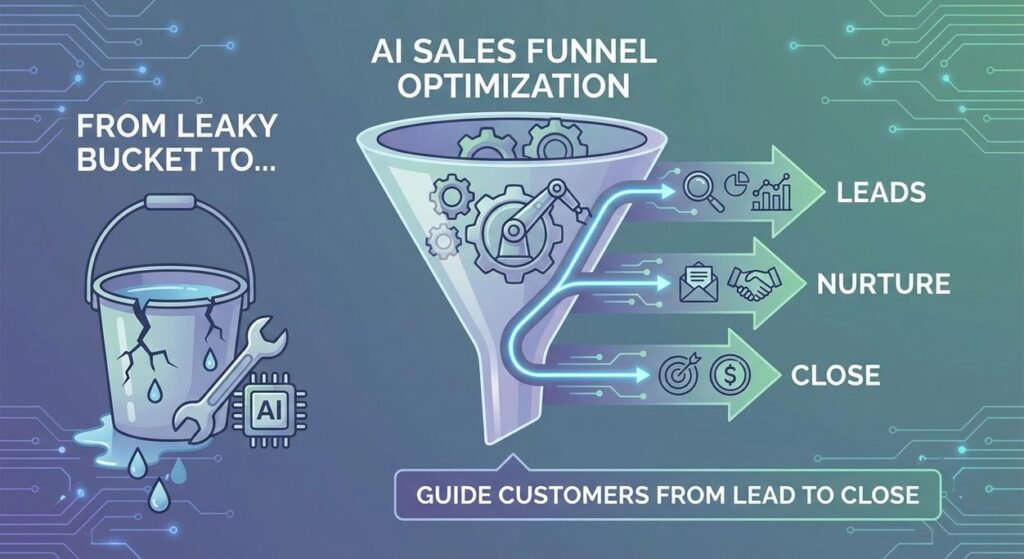
Alright, you deal-makers and revenue-drivers, let’s talk about the sales funnel. For many of you, it feels less like a smooth, well-oiled machine and more like a leaky bucket in a maze. You pour in leads at the top – from ads, content, referrals – and then you watch as some trickle out, some get stuck, and far too many simply vanish into the abyss. You’re trying to figure out who to call next, what to say, what resource to send, and when, all while juggling a hundred other priorities. It’s an exhausting, high-stakes guessing game.
It’s like trying to guide a treasure hunt, but half the clues are missing, the map is torn, and your treasure hunters keep wandering off to chase squirrels. You need a better navigator. A wise, always-on strategist who can spot the most promising paths, suggest the perfect next clue, and gently nudge your treasure hunters (your customers) toward the X on the map. What if you could deputize an AI to be that tireless, hyper-intelligent sales wingman, optimizing every step of your customer’s journey from curious glance to signed contract? Today, we’re building that wingman.
Why This Matters
This isn’t about simply automating tasks; it’s about fundamentally transforming your sales effectiveness and revenue generation:
- Higher Conversion Rates: By identifying high-potential leads and personalizing every interaction, AI dramatically increases the likelihood of moving prospects down the funnel and converting them into paying customers.
- Faster Sales Cycles: AI can predict optimal next steps and content, ensuring your sales team acts efficiently and never misses a beat, reducing the time it takes to close a deal. This means revenue hits your bank account sooner.
- Massive Time & Resource Savings: Your sales team spends less time on manual research, prioritizing leads, or figuring out what message to send. They focus on building relationships and closing deals, leading to higher productivity and lower operational costs. You’re effectively replacing or supercharging several junior sales assistants or an overworked CRM manager.
- Consistent Customer Journey: AI ensures a consistent, personalized, and relevant experience for every prospect, regardless of which sales rep is interacting with them. This builds trust and strengthens your brand.
- Data-Driven Optimization: AI learns from what works and what doesn’t. Over time, it can continuously refine its recommendations, making your sales funnel more effective and predictive.
This automation elevates your sales process from a reactive, hit-or-miss activity to a proactive, precisely engineered revenue engine. You move from chasing leads to intelligently guiding customers.
What This Tool / Workflow Actually Is
This workflow uses a Large Language Model (LLM) as an intelligent sales assistant, analyzing individual lead data to suggest optimal next steps, personalized communication, and relevant resources, all tailored to move a prospect through your sales funnel efficiently.
- Lead Data Ingestion: The AI takes in various pieces of information about a lead: their industry, company size, recent engagement with your content, previous interactions, known pain points, and current stage in the funnel.
- AI Analysis & Recommendation: Based on this comprehensive lead profile, combined with your predefined sales strategies (provided via the prompt), the AI analyzes the situation. It then recommends the "next best action" and even drafts specific outreach messages or suggests relevant content.
- Structured Output: The AI provides its recommendations and drafted content in a structured, machine-readable format (like JSON), which can then be easily integrated into your CRM or other sales tools.
What it DOES do:
- Analyze lead data to identify their stage in the funnel and potential needs.
- Suggest personalized next steps for sales reps (e.g., "send X resource," "schedule call," "follow up on Y").
- Draft personalized email snippets or talking points for outreach.
- Recommend relevant content (blog posts, case studies, videos) based on lead profile.
- Help prioritize leads based on AI-driven insights.
What it DOES NOT do:
- Replace human empathy, relationship building, and objection handling for complex deals.
- Automatically *execute* sales actions (like making calls or closing deals). It’s an assistant, not a fully autonomous sales rep.
- Spontaneously find *new* data about a lead without being explicitly fed information.
- Guarantee a closed deal (no tool can do that!).
Prerequisites
If you’ve been with us, this is a breeze. If you’re just joining, welcome! It’s all straightforward.
- An OpenAI Account: With API access and a generated API key. You’ll need some credit for usage.
- A Computer with Internet Access: Your base of operations.
- Python Installed: For our automation script.
- A Text Editor: VS Code, Sublime Text, or similar.
- Sample Lead Data (CSV file): A simple spreadsheet representing different leads in your funnel. We’ll create one.
No need to read "The Art of War" backward while juggling flaming torches. Just a few tools and a willingness to automate.
Step-by-Step Tutorial
Step 1: Get Your OpenAI API Key (or confirm you have it)
As always, your golden ticket to the AI playground:
- Go to the OpenAI Platform.
- Log in or create an account.
- Navigate to the API Keys section.
- Click "Create new secret key."
- Copy this key! Keep it handy.
Step 2: Prepare Your Sample Lead Data (sales_leads.csv)
For the AI to provide useful recommendations, it needs context. Let’s create a CSV file named sales_leads.csv with diverse lead profiles:
- Create a new file named
sales_leads.csvin your working directory. - Populate it with the following data:
- Explanation of Columns:
LeadID,Name,Company: Basic identification.Industry: Context for personalization.PainPoint: A known challenge or need.RecentEngagement: Shows interest (download, visit, attend).FunnelStage: Current stage (e.g., Lead, MQL-Marketing Qualified Lead, SQL-Sales Qualified Lead).LastInteractionDate: Helps determine urgency.
LeadID,Name,Company,Industry,PainPoint,RecentEngagement,FunnelStage,LastInteractionDate
101,Sarah Connor,Cyberdyne Systems,Tech,Slow product development,Downloaded 'AI for Devs' whitepaper,MQL,2023-11-10
102,Kyle Reese,Resistance Group,Defense,Inefficient resource allocation,Visited pricing page 3 times,SQL,2023-11-15
103,John Doe,Generic Corp,Retail,No specific pain point identified,Signed up for newsletter,Lead,2023-11-01
104,Jane Smith,Acme Corp,Manufacturing,High operational costs,Attended webinar on automation,SQL,2023-11-12
Step 3: Crafting the AI Sales Strategy Prompt
This is your instruction manual for the AI. You’ll tell it to analyze the lead and suggest concrete actions and message points, outputting in JSON.
You are an expert Sales Development Representative (SDR) for "GrowthCatalyst Solutions", a B2B SaaS company that provides AI-powered business optimization tools. Your goal is to analyze a given lead's profile and recommend the next best action and a personalized message for a sales representative.

Instructions:
1. Analyze the 'Lead Profile' provided below.
2. Determine the 'Next Best Action' for the sales rep (e.g., 'Schedule Demo Call', 'Send Case Study', 'Personalized Email Follow-up', 'Qualify Further').
3. Provide 'Recommended Content' relevant to their 'PainPoint' or 'RecentEngagement'.
4. Draft a 'Personalized Message Snippet' (3-4 sentences) that a sales rep can use in an email or LinkedIn message. Focus on their 'PainPoint' and how 'GrowthCatalyst Solutions' can specifically help.
5. Keep the tone professional, helpful, and value-driven.
6. Provide the output in JSON format with the following keys: 'Next Best Action', 'Recommended Content', 'Personalized Message Snippet'.

--- Lead Profile ---
Lead Name: {LEAD_NAME}
Company: {LEAD_COMPANY}
Industry: {LEAD_INDUSTRY}
Known Pain Point: {LEAD_PAIN_POINT}
Recent Engagement: {LEAD_RECENT_ENGAGEMENT}
Funnel Stage: {LEAD_FUNNEL_STAGE}
Last Interaction Date: {LEAD_LAST_INTERACTION_DATE}

--- GrowthCatalyst Solutions ---
Our core offerings include: AI-powered tools for streamlining operations, enhancing marketing personalization, reducing operational costs, and accelerating product development cycles. We have success stories in Tech, Defense, Retail, and Manufacturing.

Now, generate the sales strategy for this lead:
Why this prompt is effective:
- Role-Playing: "You are an expert Sales Development Representative…" sets the persona.
- Clear Goal: "Analyze… recommend the next best action and a personalized message."
- Specific Output & Constraints: Defines exactly what to generate (action, content, message snippet) and parameters (3-4 sentences, tone).
- Contextualization: Includes "GrowthCatalyst Solutions" offerings to guide AI on *how* to help.
- JSON Format & Example: Essential for consistent, machine-readable output.
- Placeholders:
{LEAD_NAME},{LEAD_COMPANY}, etc., will be filled by our Python script.
Step 4: Writing the Python Script for Funnel Optimization
Open your text editor, create a file named sales_funnel_optimzer.py in the same directory as sales_leads.csv, and paste the following code:
import os
import openai
import csv
import json

# --- Configuration --- START ---
# Set your OpenAI API key as an environment variable (recommended)
# Or, uncomment the line below and replace 'YOUR_OPENAI_API_KEY' with your actual key
# os.environ["OPENAI_API_KEY"] = "YOUR_OPENAI_API_KEY"

# Get API key from environment variable
openai.api_key = os.getenv("OPENAI_API_KEY")

if not openai.api_key:
    print("Error: OpenAI API key not found. Please set it as an environment variable (OPENAI_API_KEY) or uncomment and set it directly in the script.")
    exit()

LEAD_DATA_FILE = "sales_leads.csv"
OUTPUT_FILE = "optimized_sales_actions.csv"

# --- Configuration --- END ---

def get_sales_strategy_from_ai(lead_profile):
    lead_name = lead_profile.get('Name', 'Unknown')
    lead_company = lead_profile.get('Company', 'Unknown Company')
    lead_industry = lead_profile.get('Industry', 'General Business')
    lead_pain_point = lead_profile.get('PainPoint', 'general business challenges')
    lead_engagement = lead_profile.get('RecentEngagement', 'general interest')
    lead_funnel_stage = lead_profile.get('FunnelStage', 'Lead')
    lead_last_interaction = lead_profile.get('LastInteractionDate', 'N/A')

    prompt = f"""
You are an expert Sales Development Representative (SDR) for "GrowthCatalyst Solutions", a B2B SaaS company that provides AI-powered business optimization tools. Your goal is to analyze a given lead's profile and recommend the next best action and a personalized message for a sales representative.

Instructions:
1. Analyze the 'Lead Profile' provided below.
2. Determine the 'Next Best Action' for the sales rep (e.g., 'Schedule Demo Call', 'Send Case Study', 'Personalized Email Follow-up', 'Qualify Further').
3. Provide 'Recommended Content' relevant to their 'PainPoint' or 'RecentEngagement'.
4. Draft a 'Personalized Message Snippet' (3-4 sentences) that a sales rep can use in an email or LinkedIn message. Focus on their 'PainPoint' and how 'GrowthCatalyst Solutions' can specifically help.
5. Keep the tone professional, helpful, and value-driven.
6. Provide the output in JSON format with the following keys: 'Next Best Action', 'Recommended Content', 'Personalized Message Snippet'.

--- Lead Profile ---
Lead Name: {lead_name}
Company: {lead_company}
Industry: {lead_industry}
Known Pain Point: {lead_pain_point}
Recent Engagement: {lead_engagement}
Funnel Stage: {lead_funnel_stage}
Last Interaction Date: {lead_last_interaction}

--- GrowthCatalyst Solutions ---
Our core offerings include: AI-powered tools for streamlining operations, enhancing marketing personalization, reducing operational costs, and accelerating product development cycles. We have success stories in Tech, Defense, Retail, and Manufacturing.

Now, generate the sales strategy for this lead:
"""

    print(f"Analyzing lead: {lead_name} ({lead_company})...")
    try:
        response = openai.chat.completions.create(
            model="gpt-3.5-turbo",  # Use "gpt-4" for better quality, but higher cost
            messages=[
                {"role": "system", "content": "You are a helpful assistant designed to output JSON."},
                {"role": "user", "content": prompt}
            ],
            response_format={"type": "json_object"},
            temperature=0.4 # A bit lower for more focused, actionable recommendations
        )

        strategy_json_str = response.choices[0].message.content
        return json.loads(strategy_json_str)
    except json.JSONDecodeError as e:
        print(f"Error decoding JSON from AI response for lead {lead_name}. Error: {e}")
        print(f"Raw AI response: {strategy_json_str}") # Print raw response for debugging
        return None
    except Exception as e:
        print(f"An error occurred during AI strategy generation for {lead_name}: {e}")
        return None

# --- Main execution ---
if __name__ == "__main__":
    optimized_actions = []
    # Define the final fieldnames for the output CSV to ensure consistent order
    final_fieldnames = [
        "LeadID", "Name", "Company", "Industry", "PainPoint",
        "RecentEngagement", "FunnelStage", "LastInteractionDate",
        "Next Best Action", "Recommended Content", "Personalized Message Snippet"
    ]

    try:
        with open(LEAD_DATA_FILE, mode='r', newline='', encoding='utf-8') as infile:
            reader = csv.DictReader(infile)
            for i, row in enumerate(reader):
                strategy = get_sales_strategy_from_ai(row)
                if strategy:
                    # Merge original lead data with AI-generated strategy
                    full_record = {
                        **row,
                        "Next Best Action": strategy.get('Next Best Action', 'N/A'),
                        "Recommended Content": strategy.get('Recommended Content', 'N/A'),
                        "Personalized Message Snippet": strategy.get('Personalized Message Snippet', 'N/A')
                    }
                    optimized_actions.append(full_record)
                else:
                    print(f"Skipping lead {row.get('LeadID', 'Unknown')} due to AI processing error.")

    except FileNotFoundError:
        print(f"Error: Lead data file not found at {LEAD_DATA_FILE}")
        exit()
    except Exception as e:
        print(f"An error occurred while processing lead data: {e}")
        exit()

    if optimized_actions:
        with open(OUTPUT_FILE, mode='w', newline='', encoding='utf-8') as outfile:
            writer = csv.DictWriter(outfile, fieldnames=final_fieldnames)
            writer.writeheader()
            writer.writerows(optimized_actions)
        print(f"Successfully generated optimized actions for {len(optimized_actions)} leads to {OUTPUT_FILE}")
    else:
        print("No optimized actions were generated.")
Before you run:
- Install OpenAI library: Open your terminal or command prompt and run:
pip install openai - Set your API Key: As always, set
OPENAI_API_KEYas an environment variable. Or, for quick testing, uncomment and replace"YOUR_OPENAI_API_KEY"in the script. - Run the script: In your terminal, navigate to the directory and execute:
python sales_funnel_optimzer.py
You'll get a new file, optimized_sales_actions.csv, containing your leads with AI-suggested next steps and personalized messages!
Complete Automation Example
Let's consider "InnovateFlow," a B2B project management software company. They have a steady stream of leads coming from their website (demo requests, whitepaper downloads) and marketing campaigns. Their sales team is good, but they spend too much time manually analyzing each lead, deciding the next best interaction, and trying to personalize their outreach.
The Problem:
Leads are not nurtured consistently, leading to longer sales cycles and missed opportunities. Sales reps often resort to generic messaging or spend too much time crafting individual emails, reducing their active selling time. Lead prioritization is often based on gut feeling, not data.
The Automation:
- Lead Ingestion & Enrichment: New leads from demo forms or downloads are automatically pushed into InnovateFlow's CRM (e.g., Salesforce, HubSpot). During this process, publicly available data (company size, industry, recent news) is automatically enriched.
- Automated AI Analysis Trigger: When a new lead enters the CRM, or a lead's "FunnelStage" is updated, a webhook (using Zapier, Make.com, or an internal script) extracts the lead's entire profile (similar to our
sales_leads.csvdata) and sends it to our AI sales strategy engine (similar to our Python script, but perhaps as a cloud function). - AI-Driven Strategy Generation: The AI analyzes the lead's profile. For a new lead who downloaded a "Productivity for SaaS Teams" whitepaper, the AI might recommend "Personalized Email Follow-up" with a "Case Study on SaaS Productivity" and draft a message snippet focusing on how InnovateFlow helps SaaS teams. For a lead who visited the pricing page multiple times (SQL stage), it might recommend "Schedule Demo Call" with a message focusing on ROI.
- CRM Update & Sales Rep Notification: The AI's JSON output (Next Best Action, Recommended Content, Personalized Message Snippet) is automatically written back into specific fields in the lead's CRM record. The assigned sales rep then receives a notification (Slack, email) with the lead's details and the AI's instant recommendations.
- Action & Iteration: The sales rep now has a clear, personalized path for each lead. They can quickly review the AI's suggestions, add their human touch, and execute the next step. As deals close (or are lost), this feedback loop informs the AI to continuously improve its future recommendations.
Result: InnovateFlow's sales team is empowered to act faster and more intelligently. Sales cycles shorten, conversion rates improve, and reps spend more time on meaningful interactions instead of administrative tasks. They went from a reactive sales force to a proactive, AI-guided growth engine.
Real Business Use Cases (MINIMUM 5)
This automation is invaluable for any business with a defined sales process:
-
B2B SaaS Companies (like InnovateFlow)
Problem: Managing hundreds or thousands of leads through a complex sales cycle, ensuring personalized engagement at each stage, is challenging for sales development and account executives.
Solution: AI analyzes lead demographic data, web activity, and engagement scores to recommend specific content (e.g., product tours, case studies) and personalized outreach messages for each funnel stage, from initial contact to proposal delivery.
-
Real Estate Agencies
Problem: Nurturing potential home buyers or sellers over weeks or months, ensuring timely follow-ups with relevant property listings or market updates, is a huge manual burden for agents.
Solution: AI analyzes client preferences (location, budget, home type) and past interactions. It suggests personalized property recommendations, drafts follow-up emails for recent showings, and recommends content like "First-Time Buyer's Guide" or "Selling Your Home in a Hot Market."
-
Coaching & Consulting Services
Problem: Guiding prospective clients from initial inquiry to a paid coaching package requires highly personalized education and trust-building at each stage, which can be time-consuming for coaches.
Solution: AI processes initial inquiry details (their stated goals, challenges). It recommends personalized content (e.g., a blog post on goal setting, a free workshop recording) and drafts follow-up emails that address their specific aspirations, leading them toward a discovery call.
-
Financial Services / Wealth Management
Problem: Nurturing high-net-worth individuals through complex financial product sales, with stringent compliance requirements and a need for highly tailored advice, is a delicate and lengthy process.
Solution: AI analyzes client's financial profile, stated goals, and risk tolerance. It suggests relevant investment articles, drafts personalized meeting agendas for advisors, and identifies ideal times to present specific financial products, all while ensuring compliance with pre-approved messaging.
-
E-commerce (for High-Value Baskets or Subscription Services)
Problem: Converting abandoned carts or trial users into full-paying customers requires personalized incentives and timely reminders that are often overlooked in mass campaigns.
Solution: AI analyzes abandoned cart contents or trial usage patterns. It drafts personalized email reminders (e.g., "Don't miss out on these items!"), suggests relevant cross-sells or upsells based on their browsing history, or offers tailored discounts to convert trials into subscriptions, driving incremental revenue.
Common Mistakes & Gotchas
- No Human Oversight: This is a sales *assistant*, not a full replacement. Critical decisions, relationship building, and complex objections still require a human touch. Always have a human in the loop for review and execution.
- Garbage In, Garbage Out: The AI's recommendations are only as good as the lead data you provide. Incomplete, outdated, or inaccurate CRM data will lead to poor or irrelevant suggestions.
- Over-Automation / Losing Authenticity: Don't let the AI make your outreach sound robotic. Emphasize a human, helpful tone in your prompts, and encourage sales reps to add their unique flair.
- Ignoring Funnel Stage: An MQL needs different treatment than an SQL. Ensure your prompts clearly define actions and content relevant to each stage of your funnel.
- Hallucinations & Misinterpretations: AI can sometimes misinterpret a pain point or recommend irrelevant content. Always review the AI's output, especially early on.
- Bias in Training Data: If your historical sales data (used implicitly by the AI via your prompt's instructions) contains biases, the AI might perpetuate them in its recommendations. Be mindful of fairness.
- API Costs & Rate Limits: Processing many leads can incur costs. Monitor your OpenAI usage and consider optimization strategies (e.g., batch processing, using cheaper models for simpler tasks).
How This Fits Into a Bigger Automation System
AI sales funnel optimization is a central nervous system for a truly intelligent sales and marketing operation:
- CRM (Customer Relationship Management): This is the heart. AI recommendations are written directly into lead records, and AI can be triggered by CRM updates.
- Marketing Automation Platforms (HubSpot, Marketo, Pardot): Seamlessly trigger AI analysis from marketing qualified lead (MQL) hand-offs. AI can suggest content that marketing has already prepared, maintaining consistency.
- Email & Communication Tools: AI-drafted message snippets are pushed to email platforms, LinkedIn messaging, or even internal Slack channels for sales reps to use.
- RAG (Retrieval Augmented Generation) Systems: Connect your AI to an internal knowledge base of case studies, product documentation, competitor analyses, and sales playbooks. This allows the AI to recommend highly specific and accurate content or counter-arguments.
- Predictive Analytics: Beyond just recommending "next steps," advanced AI can predict lead conversion likelihood or potential deal size, further empowering sales teams to prioritize.
- Multi-Agent Workflows: Imagine an agent that qualifies an inbound lead, passes it to our funnel optimization agent, which then recommends actions, and finally, a third agent schedules a meeting based on the lead's availability and the rep's calendar.
What to Learn Next
You've just built a powerful system to guide your customers through the sales funnel with precision and personalization. This is a massive leap forward for any sales-driven business.
In our upcoming lessons, we'll push the boundaries even further:
- Advanced Lead Scoring & Predictive Analytics: Using AI to not just suggest actions, but to dynamically score leads and predict their conversion likelihood.
- Dynamic Content Delivery: Automating the *sending* of the AI-recommended content (e.g., case studies, whitepapers) directly to prospects.
- Multi-Channel Sales Orchestration: Expanding AI recommendations to include other channels like LinkedIn messages, personalized video snippets, or even call scripts.
- AI for Objection Handling: Using AI to pre-empt common objections and draft compelling responses for sales reps.
Get ready to close more deals, faster, and with less effort. Your sales funnel is about to become a smooth, unstoppable machine. Keep building, keep learning, and I'll see you in the next lesson!