the shot
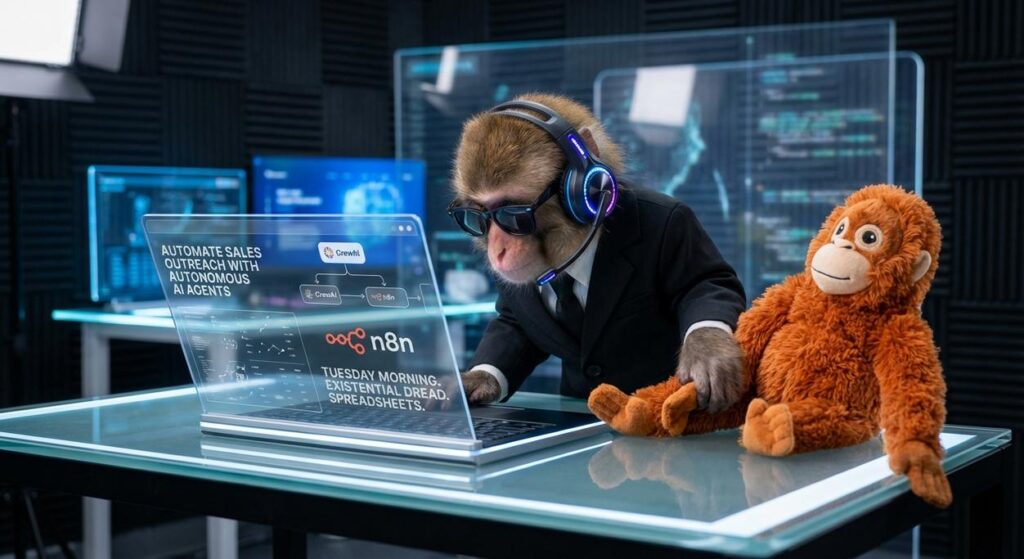
Picture this: It’s Tuesday morning. You walk into the sales department, and it smells like… well, it smells like coffee and existential dread. Your team is hunched over spreadsheets, manually copying and pasting names, desperately trying to craft another ‘hope this email finds you well’ message. Their eyes are glazed over, their spirit is slowly eroding, and the conversion rates? Let’s just say they’re doing a limbo dance with the floor.
Every lead is a snowflake, unique and special, but your team has to treat them like a generic snowdrift. Mass emails, lukewarm follow-ups, and the sheer volume of grunt work means true personalization goes out the window faster than a lead on a free trial.
What if you could clone your best sales rep? The one who actually researches the prospect, understands their pain points, and crafts a message so tailored it feels like a handwritten letter from a long-lost friend? Impossible, you say? Expensive, you cry?
What if I told you we could build an entire autonomous sales team – a small, digital army of highly specialized AI interns – that never sleeps, never complains, and can personalize outreach at scale? A team that handles the tedious research, the drafting, the follow-up orchestration, all while you sip your coffee, free from the smell of existential dread.
Why This Matters
This isn’t about replacing your sales team with robots. It’s about empowering them. It’s about taking the soul-crushing, repetitive tasks off their plate so they can focus on what humans do best: building relationships, closing complex deals, and strategizing. Think of it as giving your sales reps a superpower.
The business impact here is massive:
- Skyrocketing Conversion Rates: Personalized outreach isn’t just nice-to-have; it’s a game-changer. AI can delve into public data points, company news, and even recent social media activity to craft messages that resonate deeply.
- Massive Time Savings: No more manual lead research, no more generic email templates. Your AI ‘interns’ can do in minutes what takes a human hours, freeing up valuable time for high-level tasks.
- Reduced Cost Per Lead: By making your outreach hyper-efficient and effective, you’ll see better returns on your lead acquisition efforts.
- Consistent & Scalable Outreach: Humans get tired, make mistakes. AI agents don’t. They ensure every lead receives the same high-quality, personalized attention, consistently, at any scale.
- Improved Sales Team Morale: Take away the drudgery, and watch your team’s engagement and productivity soar. They become strategists, not data entry clerks.
This workflow replaces the frantic, often chaotic manual lead qualification, generic email blasts, and the ‘oops, I forgot to follow up with them’ moments. It turns chaos into a lean, mean, Sales Outreach Automation machine.
What This Tool / Workflow Actually Is
At its core, we’re building an autonomous system that can research a lead, generate a highly personalized outreach message, and then trigger that message to be sent via email (or other channels). We’ll be using two main stars for this show:
CrewAI: Your AI Dream Team Orchestrator
Imagine you have a complex project, and you need a team of specialists: a researcher, a writer, an editor. CrewAI is like the project manager that brings these specialists (AI Agents) together. Each agent in CrewAI has:
- A specific Role: What’s their job title? (e.g., ‘Lead Researcher’).
- A Goal: What are they trying to achieve? (e.g., ‘Find key insights about the prospect and their company’).
- Tools: What resources can they use? (e.g., a web search tool, a CRM lookup tool).
- A Backstory: A persona that defines their expertise and approach.
CrewAI orchestrates these agents to perform sequential or collaborative tasks, ensuring they work together towards a common objective – in our case, crafting the perfect sales email.
n8n: The Nervous System of Your Automation
If CrewAI is your specialized AI team, n8n is the nervous system that connects everything. It’s a powerful low-code/no-code automation platform that allows you to:
- Trigger Workflows: Start an automation based on events (e.g., new lead in a CRM, a webhook call).
- Move Data: Pull information from one system (e.g., Google Sheets, HubSpot) and push it to another.
- Execute Code/APIs: Call external services, run Python scripts, or interact with virtually any API.
- Orchestrate Complex Flows: Design multi-step automations with conditional logic, loops, and error handling.
Think of n8n as the conductor of your automation orchestra, ensuring every instrument (tool, agent, database) plays its part at the right time.
What This Workflow Does NOT Do
- Replace human judgment entirely: While autonomous, these agents still benefit from human oversight, especially for sensitive or high-value leads.
- Magic bullet, set-and-forget: Initial setup and ongoing refinement of prompts and agent instructions are crucial.
- Deep, nuanced human conversation: It automates the *initial* outreach; human sales reps are still critical for building relationships and closing.
Prerequisites
Don’t sweat it if some of these sound intimidating. I’ll walk you through them. Think of them as collecting your ingredients before baking the world’s most delicious (and automated) cake.
- n8n Account: Either n8n Cloud (easiest, what I’ll assume for the tutorial) or a self-hosted instance.
- OpenAI API Key: Or an API key from another large language model provider (like Anthropic, Google Gemini, etc.). We’ll use OpenAI for this example. Get yours here.
- Python 3.9+ Installed: We’ll be running a small Python script for CrewAI. If you don’t have it, a quick search for ‘install Python’ will get you set up.
- Basic understanding of JSON: Just knowing it’s a way to structure data (like a list with labels).
- A text editor: Like VS Code, Sublime Text, or even Notepad, to write your Python code.
That’s it! No hardcore coding, just some setup and copy-pasting. You got this.
Step-by-Step Tutorial: Crafting Your Autonomous Sales Outreach System
Alright, let’s roll up our sleeves. We’ll first build our AI sales team in Python using CrewAI. Then, we’ll connect it to n8n to put it into action.
1. Set Up Your Python Environment for CrewAI
First, open your terminal or command prompt. We need to create a dedicated space for our CrewAI project and install the necessary libraries.
- Create a Project Directory:
mkdir sales_outreach_crew cd sales_outreach_crew - Create a Virtual Environment (Recommended): This keeps your project’s dependencies separate.
python -m venv venv source venv/bin/activate # On Windows: .\\venv\\Scripts\\activate - Install Required Libraries:
pip install crewai 'crewai[tools]' python-dotenv duckduckgo-search==5.1.0crewai: The framework itself.crewai[tools]: Installs common tools for agents.python-dotenv: For securely loading API keys.duckduckgo-search: Our web search tool for agents.
- Set Up Your OpenAI API Key: Create a file named
.envin yoursales_outreach_crewdirectory. Add your OpenAI API key like this:OPENAI_API_KEY="YOUR_OPENAI_API_KEY_HERE"Replace
YOUR_OPENAI_API_KEY_HEREwith your actual key from OpenAI.
2. Define Your AI Sales Agents and Their Tools (Python)
Now, let’s write the Python script that defines our CrewAI agents. Create a file named sales_crew.py in your sales_outreach_crew directory.
from crewai import Agent, Task, Crew, Process
from crewai_tools import DuckDuckGoSearchRun
from dotenv import load_dotenv
import os
import json

# Load environment variables (API key)
load_dotenv()

# Set default LLM model. Can be overridden by OPENAI_MODEL env var.
os.environ["OPENAI_MODEL_NAME"] = os.getenv("OPENAI_MODEL", "gpt-4-turbo-preview")

# Initialize the DuckDuckGo Search Tool
search_tool = DuckDuckGoSearchRun()

# --- Define the Agents ---

# Agent 1: Lead Researcher
lead_researcher = Agent(
    role='Senior Lead Researcher',
    goal='Find comprehensive and relevant information about a potential lead and their company',
    backstory=(
        "You are an expert lead researcher with a knack for digging up "
        "valuable insights. You specialize in identifying pain points, "
        "recent achievements, and strategic initiatives of companies and individuals."
        "Your reports are always concise, actionable, and highlight key opportunities."
    ),
    verbose=True,
    allow_delegation=False,
    tools=[search_tool]
)

# Agent 2: Sales Outreach Specialist
sales_specialist = Agent(
    role='Top-tier Sales Outreach Specialist',
    goal='Craft highly personalized and compelling outreach emails that resonate with the lead',
    backstory=(
        "You are a master of persuasion and personalization. You take research-backed "
        "insights and transform them into engaging email copy that grabs attention, "
        "addresses specific needs, and clearly articulates value. Your emails are never "
        "generic and always encourage a positive response."
    ),
    verbose=True,
    allow_delegation=False,
)

# --- Define the Tasks ---

def create_sales_crew_tasks(lead_name: str, company_name: str, product_service: str):
    research_task = Task(
        description=(
            f"Conduct in-depth research on {lead_name} at {company_name}. "
            f"Focus on recent company news, financial performance (if public), "
            f"their role, recent projects/announcements, and potential challenges "
            f"they might be facing that {product_service} could solve. "
            f"Summarize key findings relevant for a sales outreach email in 3-5 bullet points."
        ),
        expected_output=(
            "A concise summary of key insights about the lead and company, "
            "specifically identifying 1-2 potential pain points or opportunities "
            "our product/service can address, and any recent achievements."
            "Format as bullet points."
        ),
        agent=lead_researcher
    )

    email_writing_task = Task(
        description=(
            f"Using the research findings for {lead_name} at {company_name}, "
            f"write a highly personalized cold outreach email. "
            f"The email should be no more than 150 words. "
            f"It MUST include a compelling subject line (max 10 words), "
            f"address a specific pain point or opportunity discovered, "
            f"and clearly introduce how {product_service} can help. "
            f"End with a clear, soft call to action. "
            f"Assume the sender is 'Alex from Automated Solutions'."
        ),
        expected_output=(
            "A complete, personalized sales outreach email in JSON format, "
            "including 'subject', 'body', and 'summary_of_research' (from the previous task output)."
        ),
        agent=sales_specialist
    )
    return research_task, email_writing_task

# --- Assemble the Crew and Run ---

if __name__ == "__main__":
    # Example Lead Data (this would come from n8n in a real scenario)
    LEAD_NAME = "Sarah Connor"
    COMPANY_NAME = "Cyberdyne Systems"
    PRODUCT_SERVICE = "AI-powered project management software"

    research_task, email_writing_task = create_sales_crew_tasks(LEAD_NAME, COMPANY_NAME, PRODUCT_SERVICE)

    crew = Crew(
        agents=[lead_researcher, sales_specialist],
        tasks=[research_task, email_writing_task],
        verbose=2, # You can set it to 1 or 2 for more detailed logs
        process=Process.sequential # Tasks will be executed one after the other
    )

    print(f"\
--- Starting Crew for {LEAD_NAME} at {COMPANY_NAME} ---\
")
    result = crew.kickoff()

    # Ensure the output is valid JSON
    try:
        # The last task's output should be our JSON email
        # Need to clean up potential markdown formatting from LLM output
        raw_output = email_writing_task.output.strip()
        if raw_output.startswith('') and raw_output.endswith(''):
            raw_output = raw_output[7:-3].strip()

        final_output = json.loads(raw_output)
        print("\
--- Crew Automation Complete ---")
        print("\
--- Raw JSON Output for n8n ---")
        print(json.dumps(final_output, indent=2))

    except json.JSONDecodeError as e:
        print(f"Error decoding JSON from CrewAI output: {e}")
        print("Raw output from sales_specialist:", email_writing_task.output)
A quick note on LLM: I’ve defaulted to ‘gpt-4-turbo-preview’ because it generally produces better results for complex tasks. If you’re using a free tier or don’t have access, you can change os.getenv("OPENAI_MODEL", "gpt-4-turbo-preview") to os.getenv("OPENAI_MODEL", "gpt-3.5-turbo"), but expect slightly less nuanced output.
3. Run Your CrewAI Script Locally
In your terminal, within the sales_outreach_crew directory, run your Python script:
python sales_crew.pyYou’ll see a lot of verbose output as your agents work, research, and collaborate. Eventually, you should see the final JSON output at the bottom, containing your personalized email and research summary.
Example Output (will vary based on LLM and current info):
{
  "subject": "Elevating Cyberdyne's Project Management with AI",
  "body": "Hi Sarah,\
\
I noticed Cyberdyne Systems' ambitious work in advanced computing, which often involves complex, multi-faceted projects. Managing these initiatives efficiently and keeping teams aligned can be a significant challenge, especially as scale increases.\
\
Our AI-powered project management software is designed to streamline workflows, predict potential bottlenecks, and automate routine tasks, freeing up your team to focus on innovation. We've helped companies like yours reduce project overhead by 20% and improve delivery times.\
\
Would you be open to a brief chat next week to explore how we could specifically support Cyberdyne's goals? We could quickly explore how our AI features integrate with your existing systems.\
\
Best,\
Alex from Automated Solutions",
  "summary_of_research": [
    "Cyberdyne Systems is a leading tech company focused on advanced computing.",
    "Sarah Connor's role involves strategic oversight in project development.",
    "Potential challenge: Managing complex, innovative projects efficiently."
  ]
}
4. Set Up Your n8n Workflow
Now that we have our CrewAI brain, let’s build the body of our automation in n8n. Log in to your n8n instance (cloud or self-hosted).
- Create a New Workflow: Click ‘New Workflow’.
- Start with a Trigger (Webhook):
- Add a
Webhooknode. This will be the entry point for your lead data (e.g., from a CRM, a form submission, or a Google Sheet). - Set the ‘HTTP Method’ to
POST. - Copy the ‘Webhook URL’ – you’ll use this to send test data.
- Click ‘Listen for Test Event’.
For testing, you can send a POST request to this URL with a tool like Insomnia, Postman, or even a simple
curlcommand. Here’s example JSON you’d send:{ "lead_name": "John Doe", "company_name": "Acme Corp", "email": "john.doe@example.com", "product_service": "AI-driven analytics platform" } - Add a
- Prepare Lead Data for CrewAI (
CodeNode – Simulating CrewAI):Since directly executing Python scripts on n8n Cloud is not straightforward without an external server, we’ll simulate the CrewAI execution by pasting the expected JSON output into a Code node for this tutorial. In a real production scenario, you’d likely call a separate API endpoint (e.g., a Flask app, AWS Lambda, Google Cloud Function) that runs your CrewAI script and returns this JSON.
- Add a
Codenode after the Webhook. - In the ‘Javascript Code’ area, paste the following. This node will act as if it *received* the output from your CrewAI script.
// This code node simulates receiving the output from your CrewAI script. // In a real scenario, you'd make an HTTP request to an API endpoint // that runs your Python CrewAI script and returns the JSON output. const leadData = $json.body; // This is the *simulated* output from our CrewAI script for the purpose of this tutorial. // REPLACE THE CONTENT OF 'crewAiOutput' WITH THE ACTUAL JSON YOU GOT from running sales_crew.py earlier. // Adjust the content for 'John Doe' and 'Acme Corp' example. const crewAiOutput = { "subject": "Elevating Acme Corp's Analytics with AI", "body": "Hi John,\ \ I've been following Acme Corp's innovative strides, particularly in your recent expansion into new markets. Managing and extracting actionable insights from vast datasets can be a formidable challenge as you scale.\ \ Our AI-driven analytics platform is engineered to transform raw data into clear, strategic intelligence, identifying trends and opportunities that might otherwise be missed. Companies leveraging our platform typically see a 15% increase in operational efficiency and more confident decision-making.\ \ Would you be open to a brief 15-minute call next week to explore how we could specifically enhance Acme Corp's analytical capabilities and support your growth?\ \ Best,\ Alex from Automated Solutions", "summary_of_research": [ "Acme Corp is a leader in its industry, expanding into new markets.", "John Doe is in a key decision-making role related to data strategy.", "Potential challenge: Extracting insights from growing datasets." ] }; return [{ json: { lead_name: leadData.lead_name, company_name: leadData.company_name, email: leadData.email, product_service: leadData.product_service, crew_output: crewAiOutput } }]; - Add a
- IMPORTANT: Replace the
crewAiOutputobject’s content with the *actual JSON output* you got from running yoursales_crew.pyscript. Adjust the subject and body for ‘John Doe’ and ‘Acme Corp’ based on your creative interpretation if you didn’t run the script for these specific inputs. - Send the Personalized Email (
GmailNode):- Add a
Gmailnode (or any other email node like SendGrid, SMTP). - Connect your Gmail account.
- Configure the node:
– From Email: Your sender email.
– To Email:{{$json.email}}
– Subject:{{$json.crew_output.subject}}
– Body:{{$json.crew_output.body}}
– Body Type:HTML(important for proper formatting of newlines).
- Add a
- Update Your CRM / Log Outreach (
Google SheetsNode):- Add a
Google Sheetsnode (or HubSpot, Salesforce, etc., depending on your CRM). - Connect your Google account.
- Set ‘Operation’ to
Append Row(orUpdateif logging against existing records). - Select your ‘Spreadsheet’ and ‘Sheet Name’ (e.g., ‘Sales Outreach Log’).
- Map the data:
– Lead Name:{{$json.lead_name}}
– Company:{{$json.company_name}}
– Email:{{$json.email}}
– Email Subject:{{$json.crew_output.subject}}
– Research Summary:{{$json.crew_output.summary_of_research.join('\(to turn the bullet points into a readable string).
')}}
– Status:Sent - Automated
– Date Sent:{{$now}}
- Add a
- Activate Your Workflow: Click the toggle switch in the top right corner to make your n8n workflow active.
Complete Automation Example: New Lead, Personalized Outreach, CRM Update
Let’s tie it all together with a practical scenario:
Scenario: A new potential client (let’s call her ‘Emily’) fills out a ‘Request a Demo’ form on your website. Your system needs to automatically research her company, craft a hyper-personalized email, send it, and log the interaction in your CRM.
- Step 1: Website Form Submission (Webhook Trigger)
Your website form (e.g., Typeform, Webflow Forms, or custom form) is configured to send a POST request to your n8n Webhook URL when a new lead submits.
Example Payload:{ "lead_name": "Emily Rhee", "company_name": "InnovateX Solutions", "email": "emily.rhee@innovatex.com", "product_service": "AI-driven customer feedback analysis tool" } - Step 2: n8n Receives & Prepares Data
TheWebhooknode in n8n captures this data. The subsequentCodenode (simulating CrewAI execution) would take this input, run the CrewAI agents (hypothetically via an API call to a server running yoursales_crew.py), and receive the personalized email content back. - Step 3: CrewAI (Behind the Scenes) Researches & Writes
Your Python CrewAI script, triggered with Emily’s info:
– TheLead Researcheragent searches for “InnovateX Solutions recent news,” “Emily Rhee InnovateX role,” looking for market challenges, product launches, or recent customer feedback initiatives.
– TheSales Outreach Specialistagent takes these findings and composes a subject line like “Elevating InnovateX’s Feedback Strategy with AI” and a body that references a specific InnovateX project or industry trend it found, then introduces your feedback analysis tool. - Step 4: n8n Sends Personalized Email
TheGmailnode then takes the subject and body generated by CrewAI and sends it directly toemily.rhee@innovatex.com. - Step 5: n8n Updates CRM
Finally, theGoogle Sheets(or HubSpot/Salesforce) node adds a new row to your ‘Sales Outreach Log’ sheet, containing Emily’s name, company, the subject of the email sent, a summary of the research, and the ‘Sent – Automated’ status.
And just like that, Emily receives a highly relevant email within minutes of her submission, without a human lifting a finger (beyond the initial setup). This is Sales Outreach Automation in action!
Real Business Use Cases
This same CrewAI + n8n automation pattern can be adapted for countless scenarios:
-
SaaS Company: Personalized Onboarding for New Users
Problem: Generic welcome emails lead to low feature adoption and high churn rates for new sign-ups.
Solution: When a new user signs up, n8n captures their industry and initial actions. CrewAI agents research common pain points in that industry and identify relevant features of your SaaS product. n8n then sends a welcome email highlighting features most valuable to their specific use case, along with links to tailored tutorials. -
E-commerce Business: Reactivating Dormant Customers
Problem: Customers haven’t purchased in 6+ months; generic discount emails are ignored.
Solution: n8n identifies dormant customers. CrewAI agents analyze their past purchase history and popular new products in those categories (e.g., “customer bought running shoes, now suggest new running apparel”). n8n sends a personalized email with targeted product recommendations and a gentle incentive, making the offer highly relevant. -
Real Estate Agency: Tailored Property Follow-ups
Problem: Agents struggle to keep up with follow-ups for hundreds of potential buyers, sending generic listings.
Solution: When a lead expresses interest in a property type/area, n8n logs it. CrewAI agents monitor new listings and market trends in that specific area. n8n then sends personalized updates to the lead, not just new listings, but also insights into market conditions or neighborhood amenities relevant to their stated preferences. -
Consulting Firm: Hyper-targeted Prospecting
Problem: Manual research for ideal client companies is time-consuming, leading to broad, less effective pitches.
Solution: Provide n8n with a list of target companies. CrewAI agents deeply research each company for recent news, strategic shifts, or public challenges they’re facing. n8n then uses these insights to draft highly specific value propositions and send them to the appropriate contact, demonstrating a clear understanding of their business. -
Event Organizer: Engagement & Reminders for Registrants
Problem: Low attendance rates for webinars/events due to forgetfulness or lack of sustained engagement.
Solution: Upon registration, n8n adds the registrant to a list. Leading up to the event, CrewAI agents research trending topics related to the event’s theme and key speakers. n8n then sends personalized pre-event emails with bite-sized insights, speaker highlights, or relevant articles, increasing excitement and reducing no-shows.
Common Mistakes & Gotchas
Even the best automation can stumble. Here are some pitfalls to watch out for:
- Garbage In, Garbage Out: If your lead data is incomplete or inaccurate, CrewAI’s research will suffer, leading to poor personalization. Quality input is paramount.
- Vague Agent Instructions: AI agents aren’t mind readers. Be explicit in their roles, goals, and especially in the
expected_outputof tasks. The more detailed your instructions, the better the output. - Over-reliance on Default LLM: While GPT-3.5-turbo is fast, GPT-4 (or equivalent top-tier models) often provides significantly better reasoning and creativity for complex tasks like sales outreach. Don’t cheap out on your ‘interns’ brains!
- Ignoring Rate Limits: LLM APIs have rate limits. If you’re processing thousands of leads simultaneously, you might hit these limits, causing delays or errors. Implement backoff strategies or process in batches via n8n.
- Lack of Human Review: Especially in the beginning, always review the AI-generated emails before sending. An AI might hallucinate or misinterpret something, leading to an awkward or even damaging message.
- Security of API Keys: Never hardcode your API keys directly into your script or commit them to public repositories. Use
.envfiles and environment variables, as shown. - Inadequate Error Handling in n8n: What happens if CrewAI’s API call fails? Or if the email sending fails? Ensure your n8n workflow has robust error handling branches to notify you or retry failed steps.
How This Fits Into a Bigger Automation System
This Sales Outreach Automation system is just one cog in the magnificent machine of a fully automated business. Here’s how it connects to other pieces:
- CRM Integration: Beyond logging outreach, this system can enrich CRM data (e.g., adding research summaries, identified pain points). It can also trigger follow-up sequences in the CRM based on email engagement.
- Email Marketing Platforms: The personalized emails generated by CrewAI can be fed into advanced email marketing platforms like Mailchimp or HubSpot Email, allowing for A/B testing, detailed analytics, and segment-specific campaigns.
- Voice Agents / Sales Bots: The research and personalized messaging logic developed here can be adapted to provide context and dynamic scripts for AI voice agents or chatbots, making their interactions with leads far more intelligent and relevant.
- Multi-Agent Workflows: This is a simple 2-agent crew. Imagine adding agents for ‘Lead Qualification’ (scoring leads based on engagement), ‘Content Generator’ (creating relevant blog posts for follow-ups), or even a ‘Legal Reviewer’ agent for compliance.
- RAG (Retrieval Augmented Generation) Systems: Integrate RAG to pull context from your internal knowledge bases (product specs, case studies, competitor analysis) to make the agents even smarter and their outputs more accurate and aligned with your brand voice.
Think of this as building a single, highly specialized factory line. You can then connect it to other factories, other assembly lines, creating a sprawling, efficient industrial complex for your entire business operation.
What to Learn Next
You’ve just built an autonomous AI sales outreach system that can research, personalize, and send emails, freeing up your team and boosting your bottom line. That’s a massive win!
But we’re just scratching the surface. In our next lesson, we’ll dive into advanced data enrichment and lead scoring using AI. How can we make our agents even smarter by feeding them more external data? How can they *prioritize* which leads to focus on? We’ll explore using more sophisticated tools and agent collaboration patterns to turn raw leads into highly qualified opportunities, ensuring your AI army is always targeting the right battles.
Get ready to refine your AI automation skills and build even more powerful systems. This course is designed to take you from ‘curious’ to ‘creator,’ one powerful automation at a time.