Hook
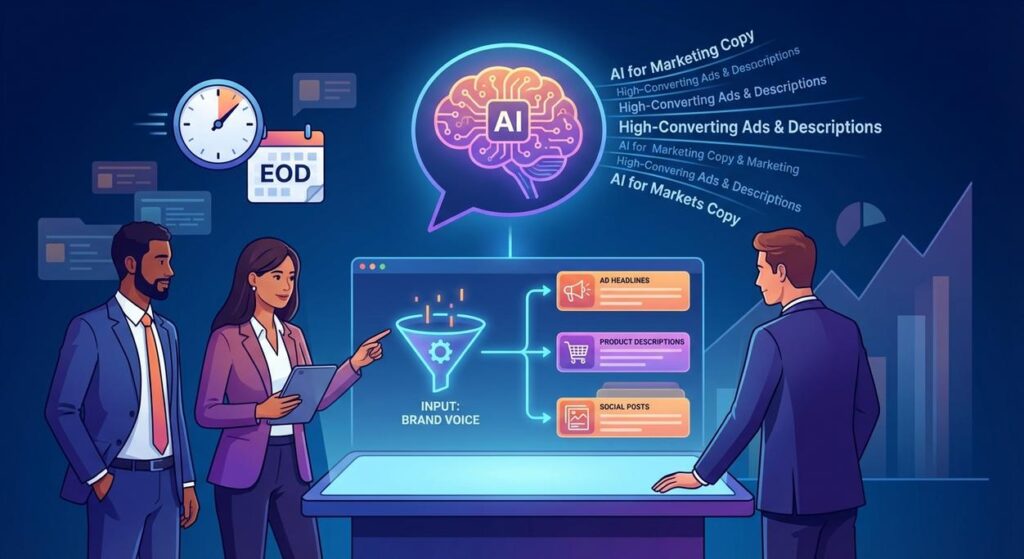
Alright, you digital alchemists and word-wizards, let’s talk about that moment. You know, the one where your boss says, "We need a new ad campaign by EOD!" or "Launch this new product, and I need killer descriptions for the website, email, and social media!" And you, a mere mortal, sit there, fingers hovering over the keyboard, staring at a blinking cursor that seems to mock your every thought. Writer’s block hits like a brick wall made of silence. You draft a headline, delete it. Write a paragraph, it sounds bland. Spend hours trying to craft something compelling, only to end up with something that feels… meh.
It’s like trying to coax a masterpiece out of a blank canvas with a single, dull crayon, while a timer ticks loudly in your ear. Exhausting, frustrating, and often, underwhelming. What if I told you that we could summon a highly creative, incredibly fast robot copywriter? A copywriter who never runs out of ideas, understands your brand’s voice, and can churn out dozens of variations of persuasive text in minutes, leaving you to simply pick the best ones? Today, we’re unleashing that robot.
Why This Matters
This isn’t just about banishing writer’s block (though that’s a divine intervention for many). This is about core business growth and efficiency:
- Scalable Content Creation: Need 5 ad variations for A/B testing? 10 product descriptions? An email sequence with 3 different angles? AI generates them almost instantly, allowing you to produce vast amounts of high-quality copy that would take a human team days or weeks.
- Massive Time & Cost Savings: Think about the agency fees or in-house hours spent brainstorming, drafting, and revising marketing copy. AI can drastically reduce this, freeing up your marketing budget for distribution and your team for strategic thinking. You’re effectively replacing or supercharging several junior copywriters or even entire marketing departments struggling with content velocity.
- Consistent Brand Voice: AI can be trained to consistently apply your brand’s specific tone, style, and messaging across all your marketing materials, ensuring every piece of copy reinforces your brand identity.
- Data-Driven Iteration: With AI, you can generate many more copy variations to test. This means more effective A/B testing, allowing you to quickly identify what resonates with your audience and iterate for higher conversion rates.
- Overcome Creative Fatigue: The pressure to be constantly creative is draining. AI provides a fresh starting point, allowing human marketers to focus on strategy, empathy, and the final polish, rather than agonizing over initial drafts.
This automation transforms your marketing copy pipeline from a slow, expensive bottleneck into a high-speed, creative engine. You move from content scarcity to content abundance, ready to fuel all your campaigns.
What This Tool / Workflow Actually Is
This workflow leverages a Large Language Model (LLM) as a sophisticated content generation engine, specifically for marketing copy. It’s like having a dedicated creative director who, given a brief, can instantly produce multiple, tailored concepts.
- Creative Brief Input: You provide the AI with all the essential elements of a marketing brief: target audience, product/service details, key benefits, desired tone, specific call to action (CTA), and the output format (e.g., ad headline, product description, email body).
- AI Generation & Refinement: The AI processes this brief, applying its vast knowledge of language and persuasive writing techniques. It then generates multiple copy options, adapting to the specified parameters.
- Structured Output: Crucially for automation, we instruct the AI to deliver its creative output in a structured format, like JSON. This makes it easy to integrate the generated copy into other systems or for immediate review.
What it DOES do:
- Generate diverse marketing copy variations (headlines, body paragraphs, CTAs).
- Adapt copy to different platforms (e.g., short for ads, descriptive for product pages).
- Adjust tone (e.g., witty, authoritative, empathetic) based on instructions.
- Brainstorm ideas and overcome writer’s block rapidly.
- Help maintain consistent messaging across campaigns.
What it DOES NOT do:
- Replace human strategic insight, empathy, or ethical judgment.
- Guarantee virality or sales without effective targeting and an appealing product.
- Spontaneously understand complex market nuances or emotional triggers without explicit guidance.
- Fact-check its own output; you must verify claims and numbers.
Prerequisites
Nothing out of the ordinary here. If you’ve been with us, you’re set. If you’re new, don’t sweat it – we keep things accessible.
- An OpenAI Account: With API access and a generated API key. You’ll need some credit for usage.
- A Computer with Internet Access: Your trusty digital workbench.
- Python Installed: For running our simple script.
- A Text Editor: Like VS Code, Sublime Text, or similar.
You’re basically ready to become a marketing content factory owner. No hefty investments, just smart tools and a little know-how.
Step-by-Step Tutorial
Step 1: Get Your OpenAI API Key (or confirm you have it)
The first step, every time, is your OpenAI API key:
- Go to the OpenAI Platform.
- Log in or create an account.
- Navigate to the API Keys section.
- Click "Create new secret key."
- Copy this key! Keep it secret, keep it safe.
Step 2: Crafting the AI Marketing Copy Prompt
This is your creative brief for the AI. The more detailed and specific you are, the better the output. We want structured output, so JSON is our friend.
Let’s create a prompt for generating a product description and a short ad copy.
You are a brilliant and persuasive marketing copywriter for "EcoGlow Skincare", a brand known for its natural, cruelty-free, and effective beauty products.

Your task is to generate marketing copy for a new product: the "Radiant Rosehip Renewal Serum".

Target Audience: Women aged 25-45, interested in natural beauty, anti-aging, and sustainable products.
Desired Tone: Luxurious, natural, effective, trustworthy, slightly empowering.
Key Benefits of Product:
- Deep hydration for youthful glow.
- Reduces fine lines and wrinkles.
- Made with organic rosehip oil, vitamin C, and hyaluronic acid.
- Cruelty-free and vegan.
- Fast-absorbing, non-greasy formula.

Output requirements:
1. A detailed product description (around 100-150 words) suitable for a website product page. Focus on benefits and natural ingredients.
2. Three short, catchy ad headlines (under 10 words each) for social media ads.
3. Three short ad body texts (under 30 words each) to accompany the headlines.

Provide the output in JSON format, with keys: 'product_description', 'ad_headlines' (an array), and 'ad_body_texts' (an array).

Example Output Structure:
{
  "product_description": "...",
  "ad_headlines": [
    "Headline 1",
    "Headline 2"
  ],
  "ad_body_texts": [
    "Body text 1",
    "Body text 2"
  ]
}

Now, generate the copy.
Why this prompt is effective:
- Role-Playing: "You are a brilliant and persuasive marketing copywriter for "EcoGlow Skincare"" gives the AI a strong persona and brand context.
- Clear Task: "Generate marketing copy for a new product…" sets the objective.
- Specific Product & Audience: Crucial for tailored, relevant content.
- Desired Tone: Ensures brand consistency in messaging.
- Key Benefits: Provides the core selling points the AI must incorporate.
- Detailed Output Requirements: Specifies types of copy (description, headlines, body), length constraints, and focus areas.
- JSON Format & Example: Essential for structured, machine-readable output that’s easy to use in subsequent automations.
Step 3: Writing the Python Script for Copy Generation
Open your text editor, create a file named marketing_copy_generator.py, and paste the following code:
import os
import openai
import json

# --- Configuration --- START ---
# Set your OpenAI API key as an environment variable (recommended)
# Or, uncomment the line below and replace 'YOUR_OPENAI_API_KEY' with your actual key
# os.environ["OPENAI_API_KEY"] = "YOUR_OPENAI_API_KEY"

# Get API key from environment variable
openai.api_key = os.getenv("OPENAI_API_KEY")

if not openai.api_key:
    print("Error: OpenAI API key not found. Please set it as an environment variable (OPENAI_API_KEY) or uncomment and set it directly in the script.")
    exit()

PRODUCT_NAME = "Radiant Rosehip Renewal Serum"
BRAND_NAME = "EcoGlow Skincare"
TARGET_AUDIENCE = "Women aged 25-45, interested in natural beauty, anti-aging, and sustainable products."
DESIRED_TONE = "Luxurious, natural, effective, trustworthy, slightly empowering."
KEY_BENEFITS = [
    "Deep hydration for youthful glow",
    "Reduces fine lines and wrinkles",
    "Made with organic rosehip oil, vitamin C, and hyaluronic acid",
    "Cruelty-free and vegan",
    "Fast-absorbing, non-greasy formula"
]

OUTPUT_FILE = "generated_marketing_copy.json"
# --- Configuration --- END ---

def generate_marketing_copy(
    product_name,
    brand_name,
    target_audience,
    desired_tone,
    key_benefits
):
    benefits_str = "\
- " + "\
- ".join(key_benefits)

    prompt = f"""
You are a brilliant and persuasive marketing copywriter for "{brand_name}", a brand known for its natural, cruelty-free, and effective beauty products.

Your task is to generate marketing copy for a new product: the "{product_name}".

Target Audience: {target_audience}
Desired Tone: {desired_tone}
Key Benefits of Product:{benefits_str}

Output requirements:
1. A detailed product description (around 100-150 words) suitable for a website product page. Focus on benefits and natural ingredients.
2. Three short, catchy ad headlines (under 10 words each) for social media ads.
3. Three short ad body texts (under 30 words each) to accompany the headlines.

Provide the output in JSON format, with keys: 'product_description', 'ad_headlines' (an array), and 'ad_body_texts' (an array).

Now, generate the copy.
"""

    print(f"Generating marketing copy for '{product_name}'...")
    try:
        response = openai.chat.completions.create(
            model="gpt-3.5-turbo",  # Use "gpt-4" for even better quality, but higher cost
            messages=[
                {"role": "system", "content": "You are a helpful assistant designed to output JSON."},
                {"role": "user", "content": prompt}
            ],
            response_format={"type": "json_object"},
            temperature=0.7 # Higher temperature for more creative variations
        )

        copy_json_str = response.choices[0].message.content
        return json.loads(copy_json_str)
    except json.JSONDecodeError as e:
        print(f"Error decoding JSON from AI response: {e}")
        print(f"Raw AI response: {copy_json_str}")
        return None
    except Exception as e:
        print(f"An error occurred during AI generation: {e}")
        return None

def write_json_output(data, file_path):
    if not data:
        print("No data to write.")
        return
    try:
        with open(file_path, 'w', newline='', encoding='utf-8') as f:
            json.dump(data, f, indent=4)
        print(f"Generated copy saved to {file_path}")
    except Exception as e:
        print(f"Error writing JSON output: {e}")

# --- Main execution ---
if __name__ == "__main__":
    generated_copy = generate_marketing_copy(
        PRODUCT_NAME,
        BRAND_NAME,
        TARGET_AUDIENCE,
        DESIRED_TONE,
        KEY_BENEFITS
    )
    if generated_copy:
        write_json_output(generated_copy, OUTPUT_FILE)
Before you run:
- Install OpenAI library: Open your terminal or command prompt and run:
pip install openai - Set your API Key: As always, set
OPENAI_API_KEYas an environment variable. Or, for quick testing, uncomment and replace"YOUR_OPENAI_API_KEY"in the script. - Run the script: In your terminal, navigate to the directory and execute:
python marketing_copy_generator.py
In a few moments, a new file named generated_marketing_copy.json will appear, filled with fresh, AI-generated marketing copy!
Complete Automation Example
Let’s imagine "FreshHarvest Organics," an online store specializing in ethically sourced, small-batch food products. They frequently launch new items, from artisanal jams to gourmet spice blends. Each launch requires unique product descriptions for their website, ad copy for Facebook/Instagram, and a snippet for their email newsletter.
The Problem:
Their small marketing team is stretched thin. Writing fresh, compelling copy for 5-10 new products every month is a huge bottleneck. Consistency in tone is hard, and ad testing is slow because generating variations takes too long.
The Automation:
- New Product Data Input: When a new product is ready for launch, the product manager fills out a simple form (or a row in a Google Sheet) with core product details: Name, Key Ingredients, Main Benefits, Unique Selling Proposition, Target Audience.
- Automated AI Copy Generation: A workflow (triggered by a new form submission or a scheduled check of the Google Sheet) takes this product data. It then automatically calls our
marketing_copy_generator.pyscript (or a similar cloud function) with the specific product details, audience, and a pre-defined brand tone for "FreshHarvest Organics." The prompt asks for: a website description, 3 email subject lines, 3 short social media ad texts, and 2 unique ad headlines. - Structured Output to Marketing Hub: The AI returns JSON with all the requested copy. This JSON is then automatically pushed to a designated section in their marketing project management tool (e.g., Asana, Trello) or a shared Google Sheet.
- Human Review & Deployment: A human marketer reviews the AI-generated copy. They make any minor tweaks for nuance or specific campaign needs, and then with a few clicks, they can copy-paste the website description into the CMS, schedule the ad copy in their ad platform, and use the email snippets for their next newsletter.
Result: FreshHarvest Organics goes from spending days crafting launch copy to minutes reviewing and deploying. They can now launch more products, test more ad variations, and maintain a consistent, high-quality brand voice across all channels, significantly boosting their marketing output and sales.
Real Business Use Cases (MINIMUM 5)
The ability to generate marketing copy on demand is transformative for various business types:
-
E-commerce Brands (like EcoGlow Skincare or FreshHarvest Organics)
Problem: Launching new products frequently requires unique, SEO-friendly descriptions, ad copy for various platforms (Google Shopping, Facebook, Instagram), and email snippets. Manual creation is a major bottleneck.
Solution: AI generates full product descriptions, ad copy sets (headlines, body, CTAs), and email marketing blurbs based on product features, target audience, and desired tone. This enables faster product launches and extensive A/B testing.
-
SaaS Companies (Software as a Service)
Problem: Announcing new features, updating landing pages, writing sales enablement materials, and creating content for various customer segments (SMBs vs. Enterprise) is a constant, demanding task for a lean marketing team.
Solution: AI drafts feature announcement copy, re-writes sections of landing pages for different personas, generates sales email sequences, and even drafts webinar descriptions. This ensures all marketing materials are consistently updated and tailored.
-
Coaches / Consultants / Online Educators
Problem: Promoting new courses, workshops, or coaching packages requires compelling sales page copy, social media posts, email sequences, and even speaker bios. Writer’s block is common.
Solution: AI generates engaging sales page sections (problem, solution, testimonials), social media promotional content, email launch sequences, and various versions of a professional bio, all tailored to the specific offering and ideal client.
-
Real Estate Agencies
Problem: Creating unique and enticing descriptions for dozens of new property listings weekly, alongside ad copy for open houses and virtual tours, is repetitive and time-consuming.
Solution: AI generates captivating property descriptions based on key features (beds, baths, square footage, neighborhood highlights, unique amenities), creates engaging social media posts for open houses, and drafts email invitations, significantly speeding up listing promotion.
-
Local Businesses (e.g., Restaurants, Spas, Boutiques)
Problem: Constantly needing fresh copy for daily specials, seasonal promotions, event announcements, and local ad campaigns. Creative ideas often run dry, and marketing takes a backseat to operations.
Solution: AI generates daily special announcements, promotional texts for loyalty programs, descriptions for new menu items or services, and local ad copy, maintaining the business’s unique voice. This ensures consistent, engaging marketing without constant manual effort.
Common Mistakes & Gotchas
- Generic Prompts = Generic Output: If your prompt is vague ("Write a product description"), the AI will give you generic copy. Be specific about audience, tone, benefits, and desired outcome.
- No Human Review: This is NOT a "set it and forget it" system for high-stakes copy. AI can still sound a bit off, make subtle factual errors, or lack true emotional resonance. Always review, edit, and add your unique human touch.
- Over-Reliance on AI for Strategy: AI generates tactics (the copy), but it doesn’t create the overall marketing strategy. That’s still your job. Use AI to execute your strategy, not define it.
- Hallucinations & Factual Errors: AI can confidently state things that aren’t true. Always fact-check any claims, numbers, or unique selling propositions generated by the AI against your actual product/service.
- Tone Drift: While you can specify tone, if you’re not consistent with your prompt, the AI’s output might subtly drift. Periodically review your prompt and its results to ensure brand voice consistency.
- API Costs & Rate Limits: Generating hundreds or thousands of pieces of copy can accumulate API costs and hit rate limits. Start small, monitor usage, and consider using cheaper models for initial brainstorming.
- Ethical Considerations: Be transparent if required, and ensure the AI-generated copy doesn’t make misleading claims or perpetuate biases.
How This Fits Into a Bigger Automation System
AI-powered marketing copy generation isn’t just a standalone magic trick; it’s a vital component in a robust marketing automation ecosystem:
- CMS (Content Management System) Integration: Automatically push AI-generated product descriptions, blog post drafts, or landing page copy directly into your website’s CMS (e.g., WordPress, Shopify, Webflow) for quick review and publishing.
- Email Marketing Platforms: Seamlessly integrate AI-generated email subject lines, body copy, and CTA’s into your email marketing tools (e.g., Mailchimp, HubSpot, ActiveCampaign), speeding up campaign creation.
- Social Media Automation: Connect AI-generated ad copy and social posts directly to your social media scheduling tools (e.g., Buffer, Hootsuite, Sprout Social), ensuring a consistent flow of content.
- A/B Testing & Optimization: Use AI to generate dozens of variations for headlines, body copy, and CTAs. Feed these into your ad platforms or email tools for automated A/B testing, and then use the performance data to refine your AI prompts for even better future output.
- Multi-Agent Workflows: Imagine an AI agent that monitors market trends, a second that brainstorms product features based on customer feedback, a third that drafts marketing copy (what we did today), and a fourth that optimizes that copy for SEO, all before a human even reviews it.
- RAG (Retrieval Augmented Generation) Systems: Instead of manually listing "Key Benefits" in your prompt, imagine your AI having access to your entire product spec sheet, customer testimonials, and competitor analysis. It could then retrieve the most compelling facts and weave them into the copy, making it even more potent and factual.
What to Learn Next
You’ve just unlocked a powerful capability: generating high-quality marketing copy at scale. This will save you countless hours and significantly boost your marketing effectiveness.
In our upcoming lessons, we’ll build on this by exploring:
- Advanced Prompt Engineering for Persuasion: Dive deeper into psychological triggers and advanced techniques to make your AI copy even more compelling and conversion-focused.
- SEO Optimization with AI: How to instruct AI to generate copy that not only converts but also ranks high on search engines, incorporating keywords and ideal structures.
- Multi-Modal Content Generation: Pairing your AI-generated text with AI-generated images or video scripts to create full content pieces automatically.
- Brand Voice Consistency at Scale: Techniques to "train" your AI on your specific brand voice so it consistently sounds like YOU, even across different content types.
Get ready to supercharge your marketing efforts and leave writer’s block in the dust. The future of content creation is here, and you’re building it. Keep pushing, and I’ll see you in the next lesson!