the shot
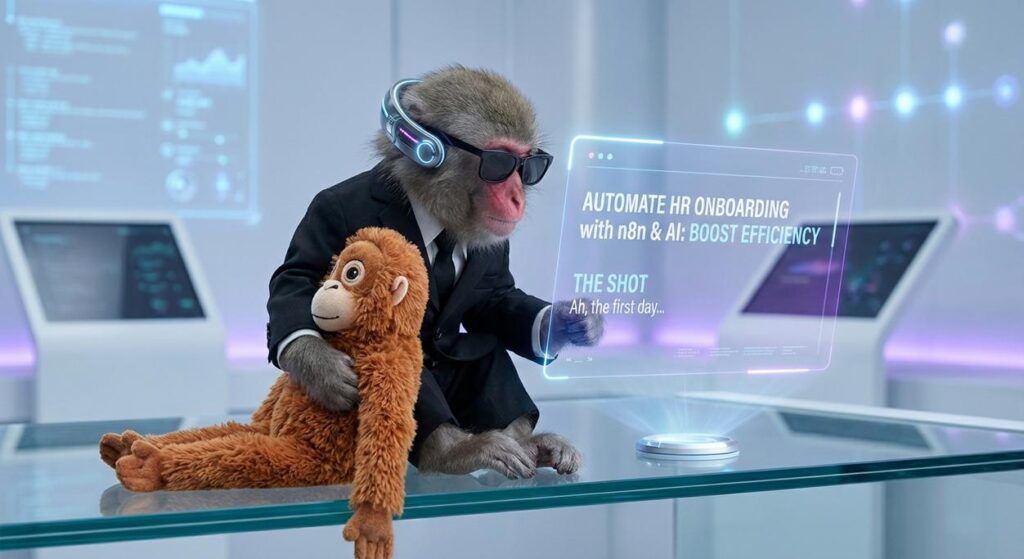
Ah, the first day. A new face, bright-eyed and bushy-tailed, ready to conquer the corporate world. Meanwhile, in the HR department, it’s less ‘welcome aboard’ and more ‘controlled demolition site’. Papers flying, forgotten passwords, a frantic search for the right forms, and Gary from HR, looking like he’s just wrestled a badger, trying to remember if he sent the IT request for ‘New Guy Mike’ or ‘Old Guy Mike who retired last week’.
It’s a scene ripped straight from a sitcom, except nobody’s laughing when it’s your business and your new hires are getting their first taste of organizational chaos. You’re losing productivity, Gary’s losing his mind, and ‘New Guy Mike’ is wondering if he made a terrible mistake. Sound familiar? We’ve all been there, or know someone who has.
Why This Matters
Manual HR onboarding automation isn’t just a productivity killer; it’s a soul-crushing, error-prone vortex of inefficiency. Think about it:
- Time: How many hours does Gary spend copy-pasting names, drafting welcome emails, assigning tasks, and chasing signatures? Multiply that by every new hire. That’s not just hours; that’s entire workdays evaporating.
- Money: Time is money, right? But also, errors cost money. Missed payroll entries, incorrect benefits enrollment, delayed access to critical systems—each can lead to direct financial costs or lost productivity for the new hire.
- Scale: Want to grow your team? Great! But if your onboarding process breaks down with every new hire, scaling becomes a nightmare. You hit a bottleneck faster than a supercar in rush hour traffic.
- Sanity: Gary deserves better. Your new hires deserve better. A smooth, professional onboarding experience sets the tone for their entire journey with your company. It boosts morale, reduces early churn, and makes everyone feel valued.
This automation replaces Gary’s manual grunt work. It replaces the frantic checklist, the forgotten steps, and the general air of ‘is anything actually going to happen?’ with a precise, consistent, and remarkably human-like system.
What This Tool / Workflow Actually Is
At its core, this workflow is your new digital HR assistant. It leverages a powerful automation platform called n8n (think of it as a digital factory floor for your data) and the cleverness of Artificial Intelligence (AI) to handle the repetitive, administrative parts of HR onboarding. When we talk about HR onboarding automation, we’re talking about a system that:
- Detects new hires: Automatically knows when someone new joins the team.
- Collects information: Pulls relevant data (name, role, start date) from your existing systems.
- Generates personalized content: Uses AI to craft unique welcome messages, initial task outlines, or even first-day itineraries.
- Distributes tasks: Assigns necessary setup tasks to IT, managers, or other departments.
- Sends communications: Fires off welcome emails, sends access links, or nudges stakeholders.
What it does NOT do: This workflow is not going to replace your HR team. It won’t decide who to hire, conduct performance reviews, or offer a shoulder to cry on. It automates the ‘robots doing boring work’ part, freeing up your human HR team to focus on strategic initiatives, employee engagement, and, well, being human.
Prerequisites
Alright, let’s get you set up. No need for a fancy degree in computer science or a black belt in coding. If you can click buttons and copy-paste, you’re golden. Here’s what you’ll need:
- An n8n account: You can either use their cloud version (super easy to get started) or self-host it (a bit more technical, but gives you full control). For this guide, we’ll assume a cloud account for simplicity.
- An OpenAI API key: We’ll use this for the AI brainpower. If you don’t have one, just sign up at platform.openai.com and generate a new secret key. Make sure you have some credits!
- A Google account: We’ll use Google Sheets as our ‘new hire’ trigger and Gmail to send emails.
- An Asana account (or similar): For creating onboarding tasks. Trello, ClickUp, Monday.com, or even a simple email to a manager could work too.
Seriously, that’s it. We’re building a digital assistant, not launching a rocket.
Step-by-Step Tutorial
Let’s build a core HR onboarding automation. We’ll set up a workflow that triggers when a new row is added to a Google Sheet (our ‘new hire’ list), uses AI to generate a custom welcome message, sends that message via email, and then creates a task in Asana for the hiring manager.
1. Set Up Your Google Sheet
Create a new Google Sheet. Name it something like "New Hires." Set up the first row with these column headers:
Name, Email, Role, Start Date, Manager EmailAdd one dummy row of data so n8n has something to test with.
2. Create a New Workflow in n8n
Log in to your n8n account. Click "Workflows" on the left, then "New workflow."
3. Add the Google Sheets Trigger Node
- Click the big "+" button or search for "Google Sheets" in the nodes panel.
- Select the "Google Sheets Trigger" node.
- Under ‘Operations’, choose "On Row Added."
- Click "Connect to Google Sheets" and authenticate with your Google account.
- For ‘Spreadsheet’, select the "New Hires" sheet you just created.
- For ‘Sheet Name’, select ‘Sheet1’ (or whatever your sheet is named).
- Click "Listen for Events" and then "Test Workflow" in the top right. Add a new row to your Google Sheet. You should see data flow into n8n. This confirms n8n is watching your sheet like a hawk.
4. Add the OpenAI (Chat) Node for AI Magic
- Click the "+" button next to the Google Sheets node, or search for "OpenAI Chat."
- Select "OpenAI Chat."
- Click "Connect to OpenAI" and paste your API key. Give it a name like "My OpenAI Connection."
- Under ‘Messages’, click "Add Item."
- Set ‘Role’ to "System" and ‘Content’ to:
You are an HR assistant creating a warm, friendly, and professional welcome message for a new employee. You should include their name, role, and a brief mention of their start date. Keep it concise and enthusiastic. - Click "Add Item" again.
- Set ‘Role’ to "User" and ‘Content’ to:
The new employee's name is {{ $json.Name }}. Their role is {{ $json.Role }}. They start on {{ $json['Start Date'] }}.These
{{ $json.Name }}are expressions that pull data directly from the Google Sheets trigger node. n8n’s expression editor is your best friend here! - Choose a ‘Model’ like
gpt-3.5-turboorgpt-4o. - Execute this node with the test data from the Google Sheet. You should see the AI generate a lovely welcome message!
5. Add the Gmail Node for Sending Emails
- Add a "Gmail" node after the OpenAI node.
- Select ‘Operation’ as "Send an Email."
- Click "Connect to Gmail" and authenticate with your Google account.
- For ‘To’, use the expression
{{ $json.Email }}to send it to the new hire. - For ‘Subject’, something like:
Welcome to the Team, {{ $json.Name }}! Your Journey Begins! - For ‘Body’, use the expression
{{ $('OpenAI Chat').item.json.choices[0].message.content }}. This pulls the AI-generated welcome message. - You can also add CC/BCC if needed.
- Execute this node to test. Check your dummy new hire’s email inbox!
6. Add the Asana Node for Task Management
- Add an "Asana" node after the Gmail node.
- Select ‘Operation’ as "Create a Task."
- Click "Connect to Asana" and follow the prompts to authenticate.
- For ‘Workspace’, select your Asana workspace.
- For ‘Project’, select an existing onboarding project (or create one).
- For ‘Name’, something like:
Onboarding: Set up {{ $json.Name }}'s workstation. - For ‘Notes’, add details like:
New hire: {{ $json.Name }}, Role: {{ $json.Role }}, Start Date: {{ $json['Start Date'] }}. Please ensure all IT, software, and desk arrangements are complete. - For ‘Assignee’, you can use the expression
{{ $json['Manager Email'] }}if your manager’s email is linked to an Asana user, or pick a default IT manager. - Execute this node. Check your Asana project to see the new task!
7. Activate Your Workflow
Once all nodes are tested and working, toggle the "Active" switch in the top right of the n8n workflow editor. Congratulations, your HR onboarding automation is live!
Complete Automation Example
Let’s see this in action for "Dr. Eliza Reed, Chief AI Ethicist".
1. Data Entry in Google Sheet
A new row is added:
Name: Dr. Eliza Reed
Email: eliza.reed@example.com
Role: Chief AI Ethicist
Start Date: 2024-10-26
Manager Email: ceo@example.com
2. n8n Google Sheets Trigger fires
n8n detects the new row and captures Eliza’s data.
3. OpenAI Chat Node generates welcome message
Prompt: "The new employee’s name is Dr. Eliza Reed. Their role is Chief AI Ethicist. They start on 2024-10-26."
AI Output:
"A warm welcome to Dr. Eliza Reed, our new Chief AI Ethicist! We're absolutely thrilled to have you join our team and bring your invaluable expertise. Your journey with us officially begins on October 26, 2024. Get ready for an exciting future!"4. Gmail Node sends personalized welcome email
To: eliza.reed@example.com
Subject: Welcome to the Team, Dr. Eliza Reed! Your Journey Begins!
Body: The AI-generated message above.
5. Asana Node creates onboarding task
Workspace: Example Corp
Project: Onboarding Tasks
Name: Onboarding: Set up Dr. Eliza Reed's AI Ethicist toolkit
Notes: New hire: Dr. Eliza Reed, Role: Chief AI Ethicist, Start Date: 2024-10-26. Please ensure her workstation is set up with specialized AI ethics software, access to relevant research databases, and an introduction to the internal AI development teams.
Assignee: ceo@example.com (or default IT/Hiring Manager)
All of this happens automatically, in seconds, without Gary lifting a finger (beyond adding the initial row in the sheet).
Real Business Use Cases
This core HR onboarding automation workflow is incredibly versatile. Here are 5 ways different businesses can leverage it:
-
Business Type: Fast-Growth Tech Startup
Problem: Rapid hiring means HR is constantly swamped, leading to inconsistent onboarding experiences and delays in new engineers getting access to critical dev tools. New hires feel lost, and time-to-productivity is high.
Solution: The automation triggers from a hiring platform’s webhook (e.g., Greenhouse). It uses AI to generate role-specific introductory notes for their manager, automatically provisions accounts in SaaS tools (Slack, Jira, GitHub) via API, creates a personalized "first week" schedule in Google Calendar, and sends an automated welcome email with IT setup instructions. This ensures every engineer gets the same, efficient start.
-
Business Type: Consulting Firm
Problem: Consultants are often onboarded directly to client projects, requiring specific client system access, project documentation, and introductions. Manual setup is error-prone and delays billable hours.
Solution: When a new consultant is assigned to a project in a CRM (e.g., HubSpot), the automation triggers. AI generates a personalized "client brief" for the consultant, the system requests client system access via a secure form, and automatically shares relevant project documents from SharePoint. Managers receive a notification to personally introduce the consultant to the client team, guided by AI-generated talking points.
-
Business Type: Retail Chain with High Turnover
Problem: Seasonal hiring surges and high turnover for part-time staff mean constant, repetitive onboarding of dozens of employees. Compliance documents (tax forms, I-9s) are a nightmare to track manually.
Solution: New hires added to the POS system (or a dedicated sheet) trigger the automation. It sends automated links to digital compliance forms (via DocuSign or similar), reminds store managers of training schedules, and generates a simple welcome message for the new team member outlining their first shift details. AI ensures consistency in messaging across hundreds of hires.
-
Business Type: Non-Profit Organization
Problem: Volunteer onboarding is often ad-hoc, leading to disengaged volunteers and legal compliance risks if background checks or consent forms are missed. Tracking volunteer availability is also a manual headache.
Solution: When a new volunteer signs up via the website (which populates a Google Sheet), the automation sends an AI-generated personalized welcome, a link to an online background check service, and digital consent forms. It then adds the volunteer to a specific communication list in Mailchimp and prompts the volunteer coordinator to schedule an orientation, making the process smooth and compliant.
-
Business Type: Marketing Agency
Problem: Onboarding new clients (not just employees) is a complex process involving contracts, brand guidelines, initial meetings, and setting up communication channels. Manual coordination often leads to missed steps and a poor initial client experience.
Solution: When a new client is marked "won" in the CRM (e.g., Salesforce), the automation kicks off. It generates a personalized welcome email with "next steps," creates a new project in the project management tool (e.g., ClickUp) with templated tasks, adds the client to a dedicated Slack channel, and notifies the account manager to schedule the kickoff call. This ensures a consistent, professional start for every client relationship.
Common Mistakes & Gotchas
Even the smoothest automation can hit a snag. Here are the common pitfalls that beginners (and even seasoned pros) stumble into:
- Forgetting to Test End-to-End: You tested each node individually? Great! But did you run the *entire* workflow from start to finish with dummy data? Often, issues only appear when data flows between several nodes.
- API Key Expiration/Limits: APIs (like OpenAI’s or Asana’s) sometimes have rate limits or keys expire. Monitor your workflows and API usage. Nothing worse than a silent failure.
- Overscripting AI Prompts: Trying to make the AI sound exactly like you can lead to overly complex prompts. Keep it simple and let the AI do its thing, then refine. Remember, it’s a tool, not a clone.
- Assuming Data Consistency: Your Google Sheet column headers change? Your HRIS exports data in a slightly different format? Your workflow will break. Always validate your input data.
- Missing Error Handling: What happens if an email fails to send? Or Asana is unreachable? n8n allows you to add error handling branches (e.g., "If email fails, send a Slack message to HR"). Don’t skip this!
- Security Concerns: HR data is sensitive. Ensure your n8n instance is secure, API keys are stored safely (n8n encrypts credentials), and you understand where your data is flowing.
- Over-automating Personal Touch: While automation is great, some things need a human. Don’t automate the "welcome handshake" or the "first coffee chat." Use automation to free up time for these meaningful interactions.
How This Fits Into a Bigger Automation System
Think of this HR onboarding automation as a crucial cog in a much larger machine. It’s not a standalone island; it’s a highly connected part of your operational nervous system:
- CRM Integration: For client-facing roles, a new hire might need access to specific client records in your CRM (Salesforce, HubSpot). This workflow can trigger that access provisioning or update client records with the new team member’s details.
- Email Marketing & Internal Comms: Beyond the welcome email, this can trigger a sequence of "getting to know us" emails, integrate with internal newsletters, or even send automated birthday wishes (with AI-generated poems, naturally).
- Voice Agents & Internal Chatbots: Once onboarded, new hires will have questions. This system can populate a RAG (Retrieval Augmented Generation) system with up-to-date policy documents, which an internal AI chatbot can then use to answer new hire queries without bothering a human.
- Multi-Agent Workflows: Imagine an "onboarding agent" that handles the initial setup, passing off to a "benefits agent" for enrollment, and an "IT agent" for hardware requests. Each agent is a sub-workflow, coordinated by a master workflow.
- RAG Systems for Policy Access: All those HR policies and training documents? Instead of burying them in a dusty folder, use this workflow to tag and index them, making them searchable via an internal AI knowledge base for new hires.
This single HR onboarding automation is just the beginning. It’s a foundational piece that touches nearly every other system in your business, making it a powerful starting point for broader digital transformation.
What to Learn Next
You’ve taken your first giant leap into automating HR onboarding, transforming Gary’s nightmare into a data-driven dream. You’re not just saving time; you’re building a better, more professional, and scalable business.
Next up, we’ll dive deeper into more advanced document generation. Imagine automatically generating employment contracts, offer letters, or even personalized training manuals with just a few clicks, all populated with data from your HR systems. We’ll explore how to connect to dedicated document generation tools and further reduce the paperwork mountain. Get ready to banish printers from your office forever!
Stay curious, keep building, and I’ll see you in the next lesson.