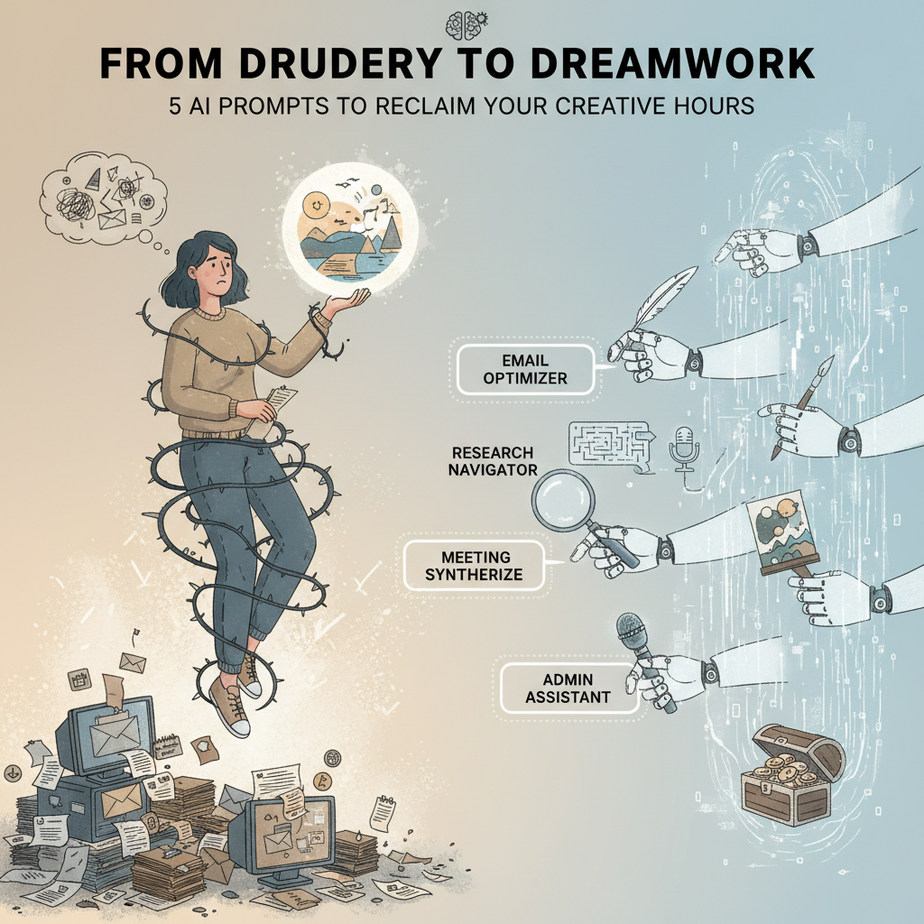

The Intern That Never Sleeps (And Doesn’t Need Coffee)
Meet Sarah. She’s a fantastic sales rep, but she spends her first two hours every morning doing detective work. A new lead comes in: “j.smith@example.com.” Sarah’s job is to become Sherlock Holmes: What company do they work for? What’s their title? Do they have a LinkedIn? What’s the company size?
She opens LinkedIn, Googles the email domain, checks Crunchbase, and maybe even tries to guess the phone number. It’s soul-crushing, tedious, and it means her first potential sale happens *after* lunch. Sarah’s not selling—she’s a data entry clerk with a high commission.
Now imagine we hire an intern. This intern has read the entire internet. It can look at an email address and instantly know the person’s name, company, job title, LinkedIn profile, company size, and funding. It works 24/7, never complains, and for a lead it cost you $0.01 to process. That intern isn’t a person—it’s an AI automation we’re building together in this lesson.
Why This Matters: The 80/20 Rule of Sales
In sales, 80% of the results come from 20% of the effort. The 80% is the actual selling: calls, demos, closing. The 20% is the prep work: research, data entry, organizing your CRM. This automation doesn’t just save time—it *reclaims* the most valuable 20% of your sales process.
Who does this replace? It replaces the manual intern you might hire to scrape LinkedIn. It replaces the hour Sarah wastes every day. It replaces the chaos of a disconnected lead list. It turns your lead list from a spreadsheet of emails into a *database* of opportunities.
The business impact is direct: faster follow-ups, better targeting, and a pipeline that scales without requiring you to hire a team of researchers.
What This Automation Actually Is
We are building a **lead enrichment workflow**. Here’s the simple, non-hype breakdown:
What it does: It takes a list of new leads (emails or names) and automatically appends additional data points like company name, industry, estimated revenue, and social profiles.
What it does NOT do: It does not write personalized outreach emails (that’s a different lesson). It does not guarantee 100% accuracy—it’s an AI, not a psychic. It does not contact the lead for you. It is a data-gathering and organizing tool, not a salesperson.
The Metaphor: Think of this as an automated assembly line for data. Raw materials (new leads) go in one end, and finished, standardized products (enriched lead profiles) come out the other. Your sales team gets to work with finished products, not raw ore.
Prerequisites
Brutal honesty time. This is a beginner-friendly lesson, but you need to be comfortable with two things:
- Basic Web Navigation: You can sign up for a service and copy-paste an API key.
- Using a Simple Form: You can fill in boxes and click “Run.”
You do NOT need to know how to code. You do NOT need to be a developer. This tutorial will use a tool called Make (formerly Integromat), which is a visual automation platform. It’s like building with Lego blocks instead of welding metal. If you can follow a recipe, you can build this automation.
Step-by-Step Tutorial: Building Your Lead Enrichment Bot
We’ll use a free-tier-friendly setup. Our tools:
- Trigger: A new row in a Google Sheet (your lead list).
- Brain: Make (for the workflow) and a free data API (like Hunter.io for email verification).
- Output: An enriched row back in your Google Sheet.
Step 1: Set Up Your Staging Area
- Create a new Google Sheet. Name it “Lead Enrichment Lab.”
- In Column A, header it
Email. - In Column B, header it
Full Name. - Add a few test leads (e.g.,
jeff.bezos@amazon.com– just for testing, don’t spam real people!).
Step 2: Get Your API Key (The Intern’s ID Badge)
We’ll use Hunter.io’s free plan. Go to hunter.io, create a free account, and find your API key in the dashboard. This key lets our automation talk to Hunter’s database. Copy it—you’ll need it in the next step.
Step 3: Build the Workflow in Make
Sign up for a free Make account. Create a new scenario (that’s what they call a workflow).
- Trigger Module: Click “Add” -> Search for “Google Sheets” -> Choose “Watch New Rows”.
- Connect your Google account. Select your “Lead Enrichment Lab” sheet and the sheet name.
- Action Module: Add a new module. Search for “HTTP” -> Choose “Make a request”. This is where we talk to Hunter.
Step 4: Configure the Hunter API Call
Set up the HTTP module like this:
URL: https://api.hunter.io/v2/lead-finder/search?email={{trigger.email}}&api_key=YOUR_HUNTER_API_KEY
Method: GET
Important: In Make, you can click in the URL field and drag from the “Email” data bubble from the Trigger module. That {{trigger.email}} is Make’s way of saying “use the email from the new row.”
Under “Headers”, add:
Key: Accept
Value: application/json
Step 5: Parse the Data and Map to Sheets
- Add a new module: “Google Sheets” -> “Add a row”.
- Map the data from the Hunter API response to your sheet columns. For example:
- Column B: Name =
data.results.0.personal.first_name(from Hunter’s response) - Column C: Company =
data.results.0.organization.domain
- Column B: Name =
Step 6: Test and Activate
Click “Run Once” in Make. Add a new row to your Google Sheet. Watch the magic happen. If it works, set your schedule to run every hour and activate the scenario.
Complete Automation Example: The B2B Agency Pipeline
Imagine you run a digital marketing agency. Your lead source is a webinar registration form that dumps emails into a Google Sheet. Before automation: every morning, your account manager (Sarah) spends 2 hours enriching 30 leads.
Post-Automation:
- A lead registers for a webinar at 10:00 PM on Tuesday.
- At 10:05 PM, the Make automation triggers.
- It enriches the lead using Hunter.io (finds company, title, LinkedIn).
- It appends a new row to the “Enriched Leads” tab in the same Google Sheet.
- The new row includes a calculated score:
=IF(Company=Target_Industry, 10, 5). A “Company Size” column populates from the API. - The account manager walks in Wednesday morning with a prioritized, researched list of 30 leads, ready to call the top 5 immediately.
The result? The first sales call happens by 9:15 AM instead of 11:00 AM. The agency looks more professional, and the lead feels more valued. Revenue velocity increases.
Real Business Use Cases
- Recruitment Agency: Problem: Tracking candidate outreach. Solution: When a candidate email is scraped from a job board, enrich it with their current company and role to tailor the outreach message.
- E-commerce B2B Supplier: Problem: Identifying which wholesale inquiries are from real businesses. Solution: Automatically check the email domain against a company database to filter out hobbyists.
- SaaS Startup Founder: Problem: Prioritizing which free trial signups to call. Solution: Enrich leads to see if their company is in a target industry (e.g., SaaS, FinTech) and flag them for immediate attention.
- Real Estate Investor: Problem: Following up on property inquiry forms. Solution: Enrich the inquiry with neighborhood data and property value estimates via APIs (using a different data source than Hunter, but the same workflow).
- Non-Profit Fundraising: Problem: Researching potential donors. Solution: Enrich donor email lists with public information about their company and giving history, allowing for more personalized ask emails.
Common Mistakes & Gotchas
- API Limits: Free plans have limits (e.g., 50 searches/month on Hunter). Always monitor your usage. Scale by upgrading or using multiple APIs (clearbit, rocketreach).
- Data Accuracy: APIs aren’t perfect. An email like
john@smith.comwon’t find data. Build in a step to flag “unmatched” leads for manual review. - Rate Limits: APIs will throttle you if you send 100 requests per second. Make has a setting to add a delay between calls—use it to avoid getting blocked.
- GDPR/Privacy: Enriching data is fine, but you cannot use it for spam. Always follow email laws. This is a tool for *understanding*, not *harassing*.
How This Fits Into a Bigger Automation System
This is Lesson 3 in our “From Lead to Revenue” course. In the bigger picture:
- Upstream: This automation feeds from your webinar forms, contact page, and lead magnets.
- Downstream: The enriched data in Google Sheets can trigger your next automations:
- Send a welcome email via your ESP (Gmail, Mailchimp).
- Sync enriched leads to your CRM (HubSpot, Pipedrive) via a Zapier/Make bridge.
- Trigger a voice agent call for high-priority leads (a future lesson!).
- Use the enriched company data to fuel a RAG (Retrieval-Augmented Generation) system that writes hyper-personalized outreach.
Think of it as the “Data Prep Station” on the factory line. You don’t paint the car before it’s built, and you don’t call a lead before you know who they are.
What to Learn Next
You now have a robotic research assistant working for you. That’s powerful. But a lead is useless if you never follow up.
In the next lesson, we’re going to tackle the **Outreach Automation Engine**. We’ll take these enriched leads and automatically generate and send a personalized first email, scheduling it for the perfect time of day. No more writer’s block. No more forgetting to follow up. Just consistent, intelligent outreach that closes deals.
You’ve built the pipeline. Now let’s turn on the tap.