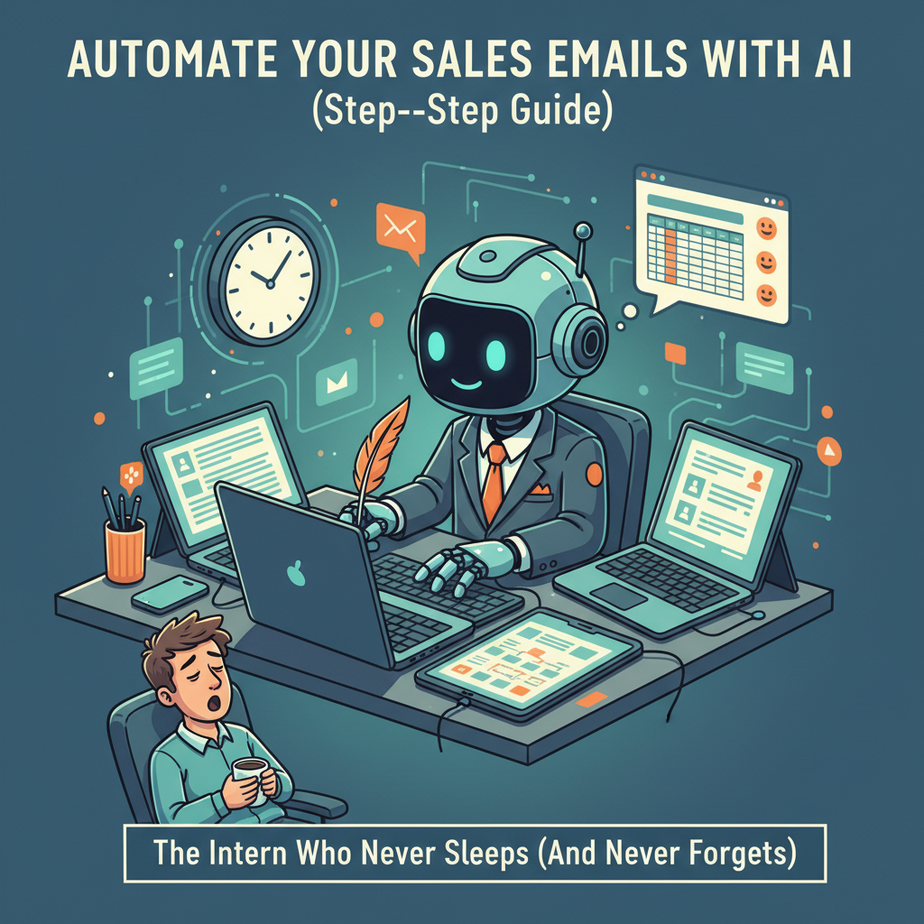
The Intern Who Never Sleeps (And Never Forgets)
Meet Alex. Alex runs a small marketing agency. Every morning, Alex opens a spreadsheet with 50 new leads, writes 50 “personalized” emails, and spends two hours hitting send. By lunch, Alex’s brain is mush. Half the emails get ignored. The other half get “Who are you again?” replies. Alex is working hard, not smart.
This is the email grind. It’s the digital equivalent of digging a ditch with a spoon. It’s boring, repetitive, and it scales like a caffeine-fueled hummingbird — not exactly a Formula 1 car.
What if you could hire an intern who works 24/7, knows every lead’s name, job title, and company pain point, and never makes a typo? An intern who sends thousands of perfectly tailored emails while you sleep, eat, or binge-watch your favorite show.
That intern is AI. And today, you’re going to build it.
Why This Matters: The Money in Your Spreadsheet
Manual email outreach is a business killer. Here’s the brutal math:
- Time: You burn 10 hours a week on 200 emails. That’s $2,000 of your time (at $50/hr) gone forever.
- Scale: You can’t manually email 1,000 leads without cloning yourself. You hit a wall at 200.
- Personalization: Generic “Hey {{first_name}}” isn’t personalization. It’s a placeholder. Your prospects can smell it a mile away.
- Revenue: More touches = more replies = more meetings = more deals. Automation is your leverage.
This automation replaces the intern, the copywriter, and the part of you that hates sending emails. It turns a chore into a scaleable revenue engine.
What This Tool / Workflow Actually Is
We’re building an AI Email Writer & Sender. This is not a magic black box.
What it DOES:
- Reads your lead list (name, company, role).
- Generates a unique, context-aware email for each lead.
- Sends the email automatically at the right time.
- Logs every sent email and tracks replies.
What it does NOT do:
- It won’t do magic. It won’t book a meeting for you. It starts the conversation.
- It won’t write a novel. It writes a concise, value-driven email.
- It won’t replace your strategy. You still need a target list and a clear offer.
Think of it as a smart conveyor belt. You feed it leads at the top, and it delivers perfectly crafted emails to your prospects’ inboxes. You just manage the flow.
Prerequisites: What You Need Before We Build
Brutal honesty time. You need a few things:
- An email account with an API (Gmail/Outlook). This lets computers send emails. We’ll use Gmail for this guide (you can adapt).
- A list of leads. A CSV file with columns like:
first_name, last_name, company, role, pain_point. If you don’t have one, use your own contact list or find a public dataset. - A free OpenAI (or similar) account. We need an AI brain. You’ll get an API key.
- Basic computer skills. Can you copy-paste and run a command? You’re good.
Don’t have an API key? Don’t panic. We’ll walk through getting one. If you can click a button and copy a key, you can do this.
Step-by-Step Tutorial: Building Your AI Email Intern
We’ll use Python because it’s the universal language of automation. If you’ve never coded, treat this like a recipe. Copy, paste, and run.
Step 1: Get Your Tools
First, install the libraries we need. Open your terminal (or Command Prompt) and run:
pip install openai pandas smtplibThis installs the three tools:
- openai: Talks to the AI brain (like OpenAI’s GPT).
- pandas: Reads your lead spreadsheet (CSV).
- smtplib: The postal service that sends your emails.
Step 2: Get Your API Keys
You need two keys. Store them safely (not in your code!).
- OpenAI Key: Go to OpenAI Platform, create a free account, and generate an API key.
- Gmail App Password: Go to your Google Account > Security > 2-Step Verification > App Passwords. Generate one. (Note: Your main Gmail password won’t work. App passwords are specific for programs).
Keep these keys handy. We’ll put them in a safe file.
Step 3: Create Your Lead CSV
Open a spreadsheet (Excel, Google Sheets). Create columns: first_name, last_name, company, role, pain_point. Fill in 5-10 rows with real or sample data. Export as leads.csv and save it where your script will run.
Example row:
first_name,last_name,company,role,pain_point
Jane,Doe,Acme Inc,Marketing Director,low website traffic
Step 4: Write the Python Script
Create a file called ai_email_blast.py. Copy this code. Read the comments to understand what each part does.
import openai
import pandas as pd
import smtplib
from email.mime.text import MIMEText
from email.mime.multipart import MIMEMultipart
import os

# --- SETUP YOUR KEYS (REPLACE WITH YOUR ACTUAL KEYS) ---
OPENAI_API_KEY = "your_openai_key_here"  # Replace this
GMAIL_USER = "your_email@gmail.com"
GMAIL_APP_PASSWORD = "your_app_password_here"  # Replace this

# --- CONFIGURATION ---
openai.api_key = OPENAI_API_KEY
MODEL = "gpt-3.5-turbo"  # Using a cheaper, faster model
SENDER_NAME = "Your Name"

# --- HELPER FUNCTIONS ---
def generate_email(lead_data):
    """Uses AI to write a personalized email based on lead data."""
    prompt = f"""
    You are a professional salesperson. Write a concise, personalized email to:
    - Name: {lead_data['first_name']}
    - Company: {lead_data['company']}
    - Role: {lead_data['role']}
    - Their stated pain point: {lead_data['pain_point']}

    The email should:
    1. Start with a personalized opener referencing their role/company/pain point.
    2. Offer one specific piece of value related to their pain point.
    3. Have a clear, low-pressure call-to-action (e.g., 'Want to see a 5-min demo?').
    4. Keep it under 150 words. Be helpful, not pushy.
    5. Sign off as {SENDER_NAME}.

    Do not add any other text. Just the email.
    """

    response = openai.ChatCompletion.create(
        model=MODEL,
        messages=[{"role": "user", "content": prompt}],
        max_tokens=300,
        temperature=0.7
    )
    email_content = response.choices[0].message.content.strip()
    return email_content

def send_email(recipient_email, subject, body):
    """Sends an email using Gmail."""
    try:
        msg = MIMEMultipart()
        msg['From'] = f"{SENDER_NAME} <{GMAIL_USER}>"
        msg['To'] = recipient_email
        msg['Subject'] = subject
        msg.attach(MIMEText(body, 'plain'))

        # Connect to Gmail server
        server = smtplib.SMTP_SSL('smtp.gmail.com', 465)
        server.login(GMAIL_USER, GMAIL_APP_PASSWORD)
        server.send_message(msg)
        server.quit()
        print(f"SUCCESS: Email sent to {recipient_email}")
        return True
    except Exception as e:
        print(f"FAILED: Could not send to {recipient_email}. Error: {e}")
        return False

# --- MAIN EXECUTION ---
def run_campaign(csv_file_path):
    """Reads CSV, generates emails, and sends them."""
    print("Starting AI Email Campaign...")

    # Load leads
    try:
        leads_df = pd.read_csv(csv_file_path)
    except Exception as e:
        print(f"ERROR: Could not read {csv_file_path}. {e}")
        return

    for index, lead in leads_df.iterrows():
        print(f"\nProcessing lead {index + 1}: {lead['first_name']} at {lead['company']}...")

        # Generate email content
        email_body = generate_email(lead)
        subject = f"Quick question about {lead['company']}"

        # Send the email (UNCOMMENT THE LINE BELOW TO ACTUALLY SEND!)
        # WARNING: This will send real emails to real people!
        # sent_success = send_email(lead['email'], subject, email_body)

        # For testing, we'll just print the email
        print("\n--- Generated Email (TEST MODE) ---")
        print(f"To: {lead['email']}")
        print(f"Subject: {subject}")
        print(f"Body:\n{email_body}")
        print("--- End Test Email ---\n")

        # Optional: Add a small delay to mimic human behavior
        import time
        time.sleep(2)  # Wait 2 seconds between emails

    print("\nCampaign finished. Review the test emails above.")
    print("If ready, uncomment the send_email line and run again.")

# --- LAUNCH ---
if __name__ == "__main__":
    # IMPORTANT: Change this to your actual CSV file path
    run_campaign("leads.csv")
Step 5: Run & Test
Save your code. Make sure your leads.csv is in the same folder. Run it from your terminal:
python ai_email_blast.pyYou’ll see output for each lead. The script prints the emails it *would* send. **This is TEST MODE.** Review the output. If it looks good, you’re ready to go live.
To activate real sending: Find the line # sent_success = send_email(lead['email'], subject, email_body) and remove the # to uncomment it. Run the script again. *You will be sending emails to real people.* Be certain your lead list is correct.
Complete Automation Example: The Real Estate Agent
Let’s see this in action for a specific business.
Business: A real estate agent specializing in high-end homes.
Problem: She manually emails 50 new “For Sale” listings every day. It’s a full-time job, and most emails are ignored. She wants to reach investors looking for rentals, but her generic emails fail.
Solution with Our AI System:
- She builds a lead CSV: Lists 100 investor leads from public records, with columns for their name, target neighborhood, and budget.
- She adjusts the prompt: Changes the script’s prompt to: “Write an email introducing a newly listed property in [neighborhood] that fits [budget]. Highlight the rental yield potential.”
- She runs the campaign: The AI emails 100 investors overnight. Each email mentions their specific neighborhood and budget range. Example subject: “A 4.2% yield property in Lincoln Park for your portfolio?”
Result: 15 replies in the morning, 5 new meetings booked. Instead of 10 hours of work, she spent 30 minutes configuring the script. The AI did the heavy lifting.
Real Business Use Cases (Beyond the Obvious)
- Recruiter: Auto-email candidates based on their listed skills and job descriptions. “I saw your Python experience and thought you’d be a great fit for our backend role at [Company].”
- B2B SaaS Founder: Email free trial users who haven’t upgraded. “I noticed you explored [Feature] but didn’t schedule a demo. Can I help unblock you?”
- Freelance Designer: Follow up with past clients after 6 months. “Hi [Name], it’s been a while. I’m doing a special offer on website refreshes. Interested?”
- Event Organizer: Invite local business owners to a workshop. “I saw [Business Name] focuses on [Industry]. Our workshop on [Topic] could help you solve [Problem].”
- Non-Profit: Thank donors with personalized notes referencing their specific donation amount and impact. “Thanks for your $100 donation. It directly funded meals for 50 kids.”
Common Mistakes & Gotchas
- Broken API Keys: The most common error. Copy-paste your keys carefully. No extra spaces!
- Gmail Security: If you get “Authentication Failed,” your App Password is wrong or 2-Step Verification isn’t on. Fix that first.
- Poor Prompt Engineering: Your email quality depends 100% on the prompt. Test, iterate, and make it specific.
- Spammy Tone: AI can sound robotic. The key is in the prompt. Always ask for “helpful, not pushy.”
- Sending Too Fast: Sending 100 emails in 2 minutes looks like spam. The 2-second delay in the script is a bare minimum. For large campaigns, use a proper email service like SendGrid.
- Not Tracking Responses: This script doesn’t track replies. For a business, you need to integrate with a CRM (like HubSpot) or use email tracking tools.
How This Fits Into a Bigger Automation System
This email writer is a single module in a powerful factory. Here’s how it connects to your full revenue engine:
1. The CRM Hub: Your lead list shouldn’t live in a random CSV. It should be in a CRM like HubSpot or Salesforce. Our script can be upgraded to pull leads directly from the CRM via its API. When a lead is added, the AI email goes out automatically.
2. The Response Handler: This is the next level. What happens when someone replies? You need an AI that reads the reply, understands the intent, and either logs it in the CRM or schedules a meeting. This is your AI Inbox Assistant.
3. The Multi-Agent Workflow: Imagine a system where one AI generates the email, a second AI (acting as a sales director) reviews and approves it, and a third AI schedules the meeting once there’s a reply. This is a multi-agent pipeline.
4. Voice Integration: Got a hot lead who replied? A voice agent can call them immediately to book a meeting while their interest is peaked. “Hi, I’m calling from [Company] about your interest in [Topic]. Do you have 10 minutes this afternoon?”
Today’s email script is your first, most essential gear. It turns cold outreach from a manual slog into a scalable process. Once this gear is spinning, you can add more gears to build a true automation machine.
What to Learn Next: The Reply Machine
You just built the robot that starts conversations. The natural next step? Building the robot that handles them.
In our next lesson, we’ll tackle AI-Powered Email Response Triage. We’ll teach an AI to:
- Read incoming replies
- Classify them (Interest, No, Maybe, Wrong Person)
- Extract key information (name, time, objections)
- Take appropriate actions (schedule meeting, add to CRM, send a follow-up)
You’ll go from sending emails on autopilot to managing an entire sales inbox on autopilot.
Ready to build the rest of your sales army? The next module is waiting for you. Don’t get left behind.