The Scene: Your Soul Dying in Column A
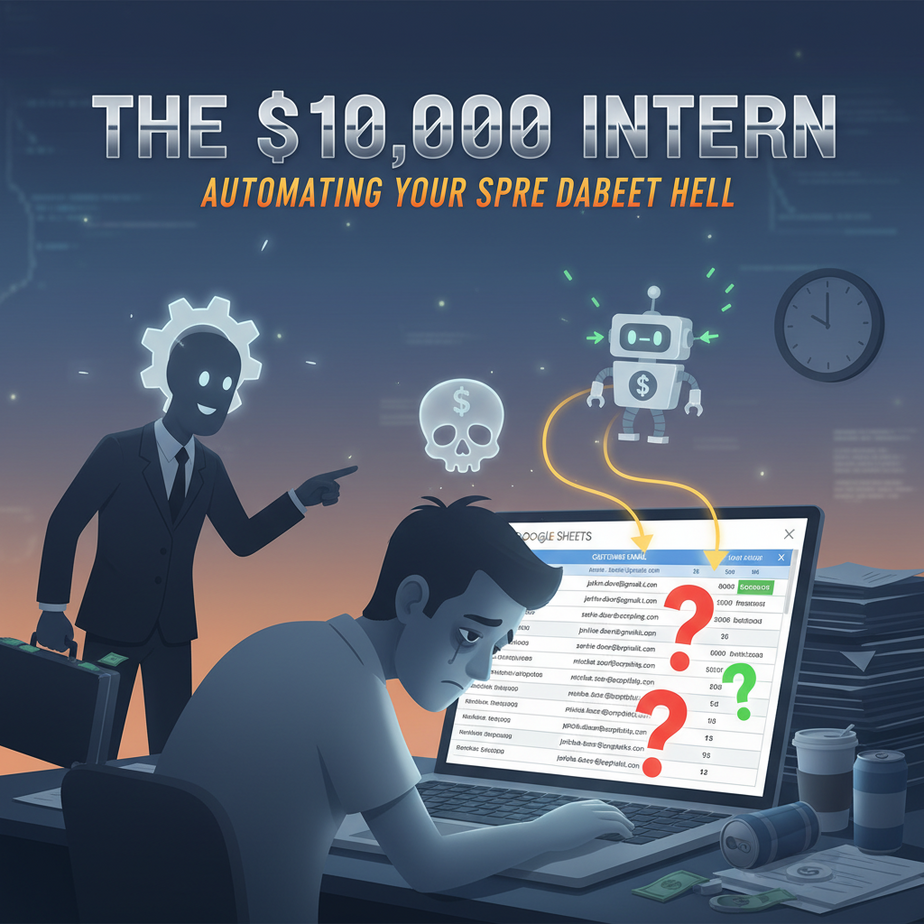
Picture this: It’s 3 PM on a Thursday. You’re staring at a Google Sheet with 500 rows of customer emails. Some are from ‘gmail.com’, some from ‘corporate.com’, some from ‘spam@paymeback.com’. You need to sort them, categorize them, and attach them to a CRM… and you’re doing it by hand. Your finger hovers over ‘Copy’. Your brain whispers, “I should have learned to code.”
This is not productivity. This is digital slavery. Your $50,000-a-year brain is being used as a pattern-matching robot, and the robot is about to unionize and quit.
Why This Matters: The Factory Floor of Your Business
Spreadsheets are the factory floor of modern business. They’re where raw material (data) gets processed into finished goods (insights). Right now, you’re probably running a manual factory. Every product (every report, every decision) requires a human to pull a lever. Scaling this means hiring more humans. That’s expensive, slow, and brittle.
What we’re about to build is an automated assembly line. We’re giving our spreadsheet a brain and a few robotic arms. The outcome isn’t just saving time. It’s about:
- Scale: Process 10,000 rows as easily as 10.
- Accuracy: Robots don’t have bad days or fat-finger typos.
- Speed: Real-time data processing means faster decisions.
- Sanity: Never sort another column again.
This isn’t just about efficiency; it’s about upgrading your role from factory worker to factory designer.
What This Automation Actually Is (And Isn’t)
What it IS: A system that uses a Google Sheet, some built-in formulas, and a lightweight AI integration to automatically extract, categorize, and format data. It’s a “Smart Data Processor.” You give it raw input; it gives you clean, actionable output.
What it ISN’T: This isn’t a complex, multi-million-dollar ERP system. We’re not building a data warehouse from scratch. We’re not writing backend services in Python. This is a practical, “start today” solution that lives where you already work: inside Google Sheets.
Prerequisites: Just a Computer & A Growth Mindset
If you can click a link and type a formula, you’re qualified. Seriously.
- A Google account (for Google Sheets).
- A browser.
- A willingness to experiment. If it breaks, you haven’t failed—you’ve learned.
No coding required. No terminal. No scary command lines. We’re using the magic already built into your spreadsheet.
Step-by-Step Tutorial: Building Your Smart Data Intern
Our mission: Build a sheet that takes a messy list of customer information and automatically generates a clean, categorized table for your sales team.
Step 1: Set Up Your Raw Data
Open a new Google Sheet. Name it “Master Data”. In columns A, B, and C, create the following headers: Email, Sign-Up Date, Notes. Paste your messy data here. Make it ugly—mix case, add typos, throw in a null cell.
Step 2: The Cleanup Crew (Formulas)
We’ll create a new sheet named “Clean Data”. We’ll use formulas to standardize the email addresses. In cell A2 of the “Clean Data” sheet, enter this formula to normalize the email to lowercase and trim spaces:
=TRIM(LOWER('Master Data'!A2))Drag this formula down for all your rows. This is your first automated process.
Step 3: The Categorization Engine (IF + FIND)
Now, let’s categorize our customers by domain. In a new column D, header “Segment”, we’ll classify them as “Gmail”, “Corporate”, or “Other”. In cell D2 of “Clean Data”, enter:
=IF(ISNUMBER(FIND("gmail.com", A2)), "Gmail", IF(ISNUMBER(FIND("@", A2)), "Corporate", "Other"))What this does: It checks if “gmail.com” is in the email. If yes, “Gmail”. If not, but an “@” symbol exists (meaning it’s a valid email format), it’s “Corporate”. Otherwise, “Other”. This is your first logical decision-making robot.
Step 4: The AI-Powered Insight Layer
Here’s where we add intelligence. We’ll use the free “AI Functions” add-on for Google Sheets. Go to Extensions > Add-ons > Get add-ons. Search for and install “AI Functions”. Once installed, it will add a new menu item.
Our goal: Automatically extract the company name from the email address. For example, from “john@acme.com”, we want “Acme”. In column E, header “Extracted Company”, we use the AI function. The syntax is =AI_FUNCTION().
For cell E2, enter this formula. It uses an AI prompt:
=AI_FUNCTION(A2, "Extract the company name from this email address, capitalize it. Only output the company name. Example: john@acme.com -> Acme")This formula sends A2 to the AI model with your instructions. The AI processes it and returns “Acme”. It does this for every row you drag it down to.
Step 5: The Final Dashboard
Create a final sheet named “Dashboard”. Use simple summary tables. In your “Dashboard” sheet, create a table like this:
| Segment  | Count | Average Sign-Up Date |
|----------|-------|----------------------|
| Gmail    | =COUNTIF('Clean Data'!D:D, "Gmail") | =AVERAGEIF('Clean Data'!D:D, "Gmail", 'Clean Data'!B:B) |
| Corporate| =COUNTIF('Clean Data'!D:D, "Corporate") | =AVERAGEIF('Clean Data'!D:D, "Corporate", 'Clean Data'!B:B) |
Now you have a live-updating dashboard. Change the raw data in “Master Data”, and your “Dashboard” updates automatically.
Complete Automation Example: E-Commerce Lead Processor
Scenario: You run an online store. Your “Master Data” sheet is a form submission log from your website. Every day, you get 50+ new leads with names, emails, and “notes” about what they asked for.
Automated Workflow:
- Raw Data: “Master Data” sheet gets form submissions.
- AI Classification: Using an AI function like
=AI_FUNCTION(B2, "Classify this user query as 'Pricing', 'Technical', or 'General Inquiry' based on the notes."), the system automatically tags each lead. - Dynamic Routing: Add a column that uses a formula to assign an owner.
=IF(C2="Pricing", "Sales Team", IF(C2="Technical", "Support Team", "CEO")) - Automated Reporting: The Dashboard sheet has a pivot table summarizing lead volume by category and team. You now have a real-time view of your customer interests without any manual data entry.
- Marketing Agency: Problem: Manually tagging incoming leads from 10 different ad campaigns. Solution: Use AI to scan the lead’s “message” field and auto-tag with the ad campaign source (e.g., “Facebook Ad A” vs. “Google Ad B”).
- HR Recruiter: Problem: Sorting hundreds of resume submissions for specific keywords. Solution: Use an AI function to scan the resume text (pasted in a sheet) and output a score for “Technical Skills,” “Leadership Experience,” etc.
- Real Estate Agent: Problem: Tracking client inquiries about different property types. Solution: Auto-categorize incoming inquiry messages into “Condo,” “Single-Family Home,” “Commercial,” and assign to the relevant agent.
- Consultant (e.g., Financial): Problem: Tracking client meeting notes and extracting actionable next steps. Solution: AI scans the meeting notes column and outputs a summarized “Action Item” in a new column. The dashboard then tracks open action items by client.
- Non-Profit: Problem: Managing donor data from events and forms. Solution: Auto-segment donors by “Event Attended” and “Donation Tier” for targeted thank-you campaigns.
- The $500 Bill: Some AI add-ons have usage limits. Start with the free tier. Monitor your usage to avoid surprise costs. Always check the pricing model.
- Formula Garbage In, Garbage Out: If your raw data is catastrophically bad, your automation will be too. Spend 10 minutes cleaning the header row. It’s worth it.
- Over-Reliance on AI: The AI is your intern, not your CFO. Use it for categorization, summarization, and extraction—not for financial calculations or final decisions. You (the human) are still the boss.
- Not Naming Ranges: If your data grows, use
Named Ranges(Data > Named Ranges) to make your formulas more readable and easier to update.=COUNTIF(leads, "Pricing")is better than=COUNTIF('Clean Data'!D:D, "Pricing"). - CRM Integration: Use tools like Zapier or Make (Integromat) to automatically push a row from “Clean Data” to your CRM (HubSpot, Salesforce) when the “Segment” is “Corporate.” Trigger this based on a checkbox.
- Email Automation: When a new lead is tagged “Pricing” in your sheet, a Zapier automation could trigger an immediate welcome email with a pricing guide PDF from your Gmail.
- Voice Agent Handoff: Imagine a customer leaves a voicemail. A transcription service emails you the text. You paste it into the sheet. The AI function categorizes the inquiry, and the system auto-sends an email saying, “Thanks for your call! A support agent will email you within the hour.”
- Multi-Agent Workflow: This sheet becomes the central “dispatch board” for a team of AI agents. One agent categorizes, another drafts a response, another updates the CRM, and a final agent checks for completion—all triggered by changes in this Google Sheet.
- RAG Foundation: This curated, clean data can become your first data source for a future RAG (Retrieval-Augmented Generation) system. You’ve built a structured knowledge base of your customer interactions.
Real Business Use Cases (MINIMUM 5)
Common Mistakes & Gotchas
How This Fits Into a Bigger Automation System
This smart spreadsheet is the brain stem of your operational system. It can connect to more powerful limbs:
What to Learn Next: From Sheets to Systems
You’ve just built a self-service data processing engine. You’ve replaced a spreadsheet intern with a smart robot. You’re no longer just using data; you’re orchestrating it.
In our next lesson, we’ll connect this engine to the outside world. We’ll build an automated system that ingests data from an email inbox, processes it through your smart spreadsheet, and sends personalized, AI-generated follow-ups. Imagine waking up to a list of 50 qualified leads, each already segmented and assigned, with draft follow-ups ready for your review.
This is the start of the course. The next step is going from a single automated tool to a connected automation system. Your business doesn’t run on one spreadsheet, and neither will your automation.
Stay curious. Keep experimenting. And never, ever copy-paste column A again.
“,
“seo_tags”: “Google Sheets Automation, AI Data Processing, Business Automation, Spreadsheet Formulas, Zapier, AI Functions, Workflow Automation”,
“suggested_category”: “AI Automation Courses